GCoM Latin America Mayors Forum drives regional action to expand climate finance for cities
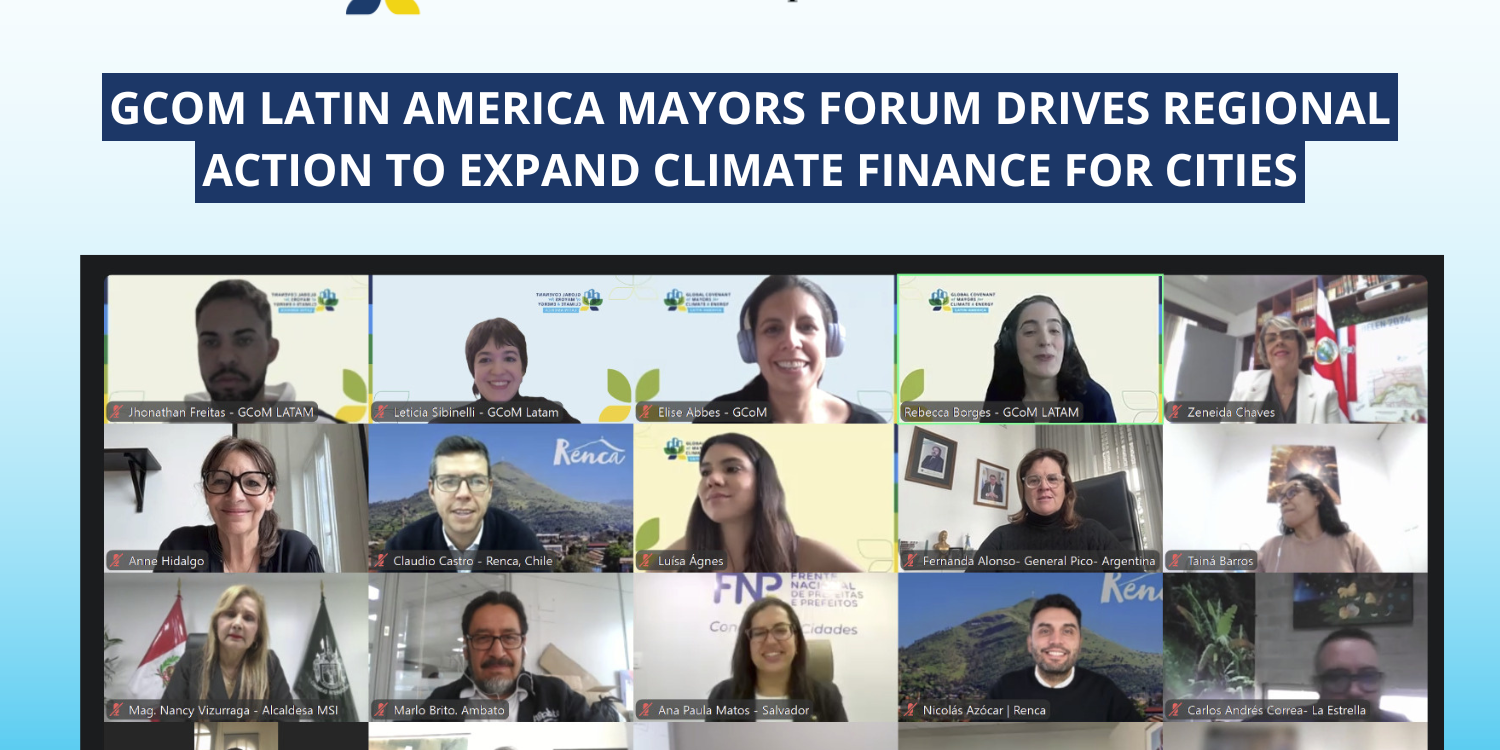
The virtual meeting held on June 9th brought together the 16 member municipalities from 8 countries, featured the special participation of Anne Hidalgo and consolidated a 2026 roadmap focused on bankable projects, regional cooperation and international advocacy.
Latin American cities no longer want to be seen merely as local implementers of commitments defined at other levels. They want to be at the table from the design stage, with a voice, resources and recognition. That was the central message of the virtual meeting of the Mayors Forum of the Global Covenant of Mayors for Climate and Energy (GCoM) in Latin America, held on June 9th, which marked a moment of political and technical maturity for the alliance in the region.
The meeting brought together the 16 member municipalities from 8 Latin American countries, featured the special participation of Anne Hidalgo, former mayor of Paris and Global Ambassador of GCoM, and consolidated a 2026 roadmap structured around three central pillars: expanding access to climate finance, building a portfolio of bankable municipal projects and strengthening the international advocacy of Latin American cities.
The meeting also reflected GCoM’s new strategic phase in Latin America. In 2026, the alliance begins a new funding cycle, aligned with the Global Strategic Plan 2026–2028, with the aim of deepening support for the implementation of local climate action, strengthening regional ownership of GCoM in Latin America and the Global South, and increasing the visibility of the alliance’s tenth anniversary.
Governing from the street, not from the negotiating table
In his opening remarks, the president of the Forum, Claudio Castro, mayor of Renca, Chile, voiced a concern shared by many local governments: the gap between climate commitments made at the international level and the real conditions for implementation in the territories. “For far too long, cities have been left out of the room where the commitments we are later expected to implement are decided,” he said.
Castro also directly addressed one of the main paradoxes of climate decentralization. For the Forum president, local governments hold a particular legitimacy because they face the impacts of climate change in people’s everyday lives. “We do not govern from the heights of a negotiation. We govern from the street. And that gives us a different responsibility, and also a different legitimacy,” he said.
In this context, he highlighted his selection as one of 12 subnational leaders worldwide to join the Advisory Council of CHAMP, the Coalition for High Ambition Multilevel Partnerships. For Castro, the recognition carries a broader political meaning. “If the multilateral system had to create a specific coalition to integrate subnational governments, it is because it recognized that without cities, national commitments cannot be fulfilled,” he said.
The mayor also brought to the dialogue Chile’s Framework Law on Climate Change, enacted in 2022, as an experience with the potential to inspire other countries in the region. The legislation establishes that the country’s 345 municipalities must develop communal climate action plans aligned with the national NDC, not as a voluntary invitation, but as a legal mandate with deadlines, audits and consequences.
“That architecture can be exported. And GCoM has an active and strategic role to play: supporting Latin American countries in designing regulatory frameworks that integrate cities as binding actors in national climate commitments,” he argued.
Anne Hidalgo: finance, guarantees and the global role of mayors
GCoM Global Ambassador Anne Hidalgo was emphatic in reinforcing the role of cities in implementing the climate agenda. “Where development happens, where things are done and where action takes place is in cities and local governments,” she said.
For Hidalgo, the relationship between local governments, national governments and international institutions is a structural condition for climate commitments to translate into real action. In her remarks, she stressed two points that ran throughout the meeting: direct access to climate finance for local governments and the need for guarantees to make that access viable.
The former mayor of Paris cited CAF’s subnational finance model as a reference with potential for replication in other regions, including Africa, and issued a clear challenge for the Forum’s communication efforts. “We need to talk about the cost of climate inaction and the benefits of action, with data, images and finance,” she said.
Hidalgo also anticipated her participation in upcoming events in Latin America. Her remarks underscored the region’s growing role in the global climate agenda and her interest in closely supporting the Forum’s work.
Concrete projects: turning ambition into finance
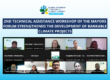
The meeting advanced two central priorities of the 2026 work plan. The first is the specialized technical assistance that the Forum’s 16 municipalities are receiving in areas prioritized for the region: adaptation, waste and mobility. Following the first virtual workshop, held in May, municipal teams are moving forward with the development of concept notes to structure projects with greater financing potential.
This process is part of one of the main lines of action of GCoM’s regional strategy: providing technical support and strengthening capacities for the planning and implementation of local climate action. The methodology follows a progressive path, from identifying the climate challenge and municipal capacities to defining solutions, designing a financing roadmap and reviewing concept notes.
The second technical meeting is scheduled for June 25, with a clear goal: to build a portfolio of 16 projects, one per city, ready to be presented to financial institutions and private actors before November. Castro emphasized the importance of this process. “It is not enough to want to do something on adaptation. We need to define the problem, the scope and the financing pathway. That discipline is exactly what climate funds require,” he said.
The second priority is the strategic alliance with CAF, which includes coordination with the BiodiverCities network, projects aimed at the Adaptation Fund, training agendas and other joint activities. The objective is to shorten the path between international funds and local projects, creating a model that can also serve as a reference for other regions of the Global South.
Voices from the region: South-South cooperation and solar energy on the agenda
During the round of interventions, the meeting highlighted both the diversity of contexts and the convergence of demands among the Forum’s cities. The mayor of Belén, Costa Rica, Zeneida Chaves, emphasized biodiversity as a central pillar of her climate agenda. The mayor of San Isidro, Peru, Nancy Vizurraga, deepened the discussion on specific financing for municipalities. The vice mayor of Salvador, Brazil, Ana Paula Matos, advocated for expanding cooperation among cities. “One city can support another through mentorship, sharing the areas in which it is strongest,” she said.
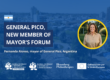
The mayor of General Pico, Argentina, Fernanda Alonso, a new member of the Forum, set the tone for her arrival in the regional space. “We intend to learn, contribute and build,” she said.
Solar energy projects also played a prominent role in the debate, with experiences presented by representatives of Ambato, Ecuador; General Pico, Argentina; and Salvador, Brazil. Representatives from Costa Rica also pointed to regulatory barriers that still limit local clean energy generation. The mayor of Oreamuno, Costa Rica, Erick Jiménez, summarized the sense of urgency that ran through the meeting: “The clock is ticking. We need to show what we are doing now.”
October campaign: impact, not intention
The communication segment defined the guiding lines for the Forum’s joint campaign, scheduled for the week of October 24 to 31, within the framework of the International Day of Climate Action and World Cities Day. Castro proposed that the thematic focus should be climate finance for cities, with an emphasis on nature-based solutions and sustainable water management, directly linked to the ongoing technical assistance work.
The discussion converged around one principle: communication must show impact, not only intention. This means starting from concrete results, such as emissions reductions, water savings, renewable energy generation and increased urban resilience, while also involving residents as protagonists of local climate action.
The proposal to work with the notion of a “climate clock” gained traction as a way to translate the technical agenda for citizens. A minimum common format prepared by the Secretariat was suggested, allowing each city to adapt it to its own territory and multiply the campaign’s reach without relying on a single regional statement.
A regional agenda to strengthen local climate action
The meeting reaffirmed the role of the Mayors Forum as a space for leadership, governance and political advocacy for GCoM in Latin America. In the 2026 regional strategy, the Forum stands out as one of the main platforms to consolidate emblematic cities, amplify the voice of local governments and connect urban climate action with national and international agendas.
In addition to technical support for bankable projects, the regional plan includes actions related to reporting and recognition of progress, communication of GCoM badges, capacity-building, collaboration with regional partners and coordination with initiatives such as Brazil’s Mutirão Program, with the potential to replicate lessons learned on data, climate budgeting, the Amazon approach, multilevel coordination and thematic approaches in Latin American cities.
By the end of the meeting, it was clear that the Forum’s 2026 agenda is not limited to discussing climate ambition. The goal is to turn that ambition into projects, resources, cooperation and visible results for citizens. In a context of climate urgency, Latin American cities are seeking to occupy the place that belongs to them: not only implementing commitments, but participating in their design, financing and execution.