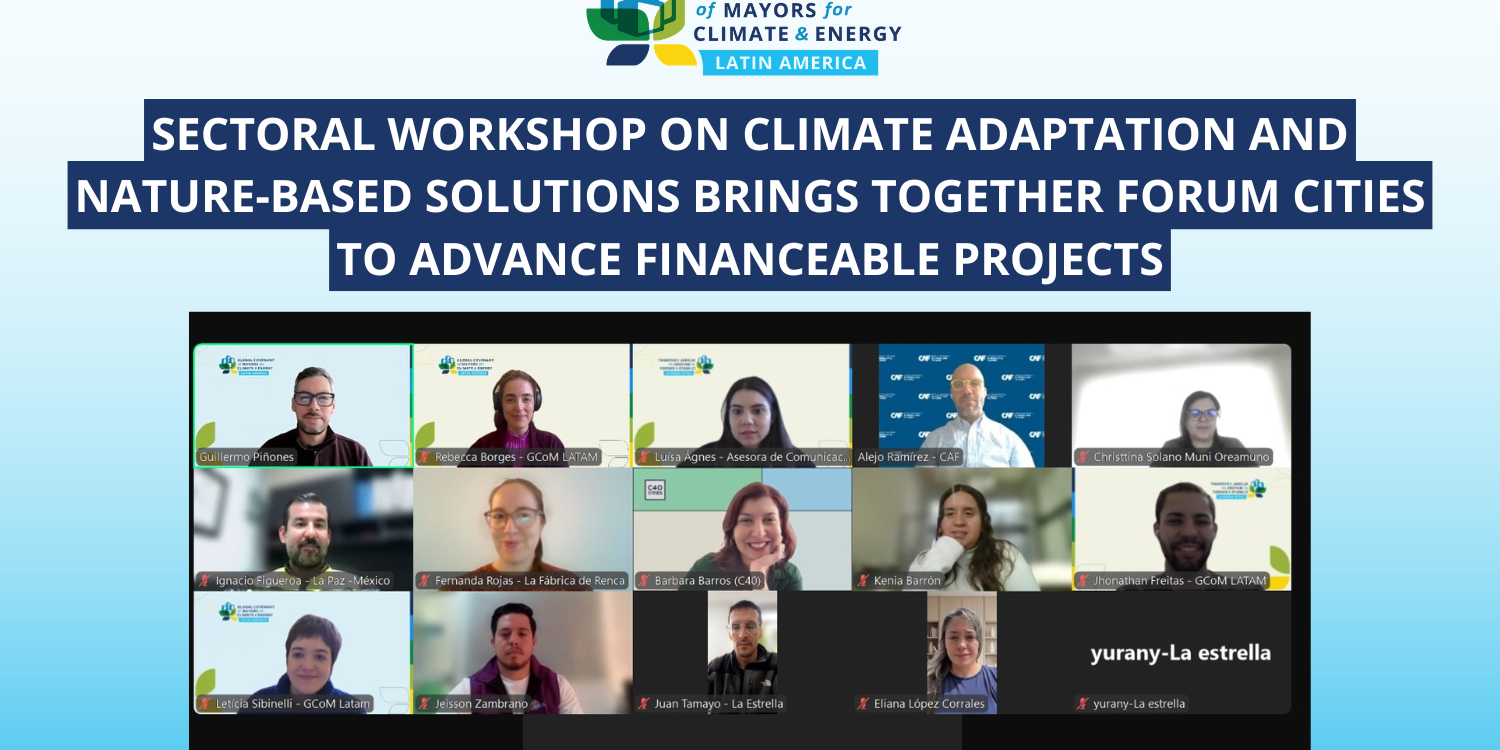
Sectoral workshop on climate adaptation and nature-based solutions brings together Forum cities to advance financeable projects
The meeting, held on July 17 with the participation of GCoM, CAF and C40, addressed how to transform climate diagnostics into urban adaptation projects with real capacity for implementation and financing
The Global Covenant of Mayors for Climate and Energy in Latin America (GCoM) held, on July 17, the Sectoral Workshop on Climate Adaptation and Nature-Based Solutions, as part of the technical assistance process directed at the cities of the Mayors’ Forum.
The meeting brought together representatives of Forum cities, GCoM specialists and representatives of partner institutions to discuss how to transform climate diagnostics into financeable projects. The agenda included the participation of Guillermo Piñones, climate finance advisor who coordinates GCoM Latin America’s Technical Assistance; Alejo Ramírez, principal executive at CAF and general coordinator of the BiodiverCities Network; and Bárbara Barros, Global Head of Climate Adaptation at C40.
The activity is part of the technical assistance process launched by GCoM in April, aimed at strengthening cities’ capacities in the preparation of climate projects. According to Guillermo Piñones, the agenda responds to priorities defined by the Forum’s own local leaders: “This process, launched in April of this year, moved forward to identify project areas. What brings us together today are the sectors of climate adaptation, solid waste management and sustainable mobility, which were the priorities defined by the mayors of the Forum for project development.”
CAF and the BiodiverCities agenda
In his intervention, Alejo Ramírez presented CAF’s experience in supporting subnational governments and highlighted the expansion of the bank’s green agenda and the role of cities in protecting biodiversity, strengthening urban resilience and promoting sustainable development. He also presented the BiodiverCities Network, an initiative that connects municipalities across the region and promotes an integrated perspective on nature, urban planning and quality of life.
“CAF has committed to ensuring that at least 50% of its operations have green components. The BiodiverCities Network seeks not only to be the bank of subnational governments, but to lead clients toward paths of greater impact in caring for life, with incentives linked to rates and technical cooperation,” Ramírez said.
His participation reinforced the importance of connecting the technical preparation of projects with real financing opportunities. For municipalities, this means advancing proposals with clear objectives, demonstrable benefits, defined governance and the capacity to generate environmental, social and economic impact.
Projects as business cases
Bárbara Barros, from C40, addressed the elements that can make an adaptation project more attractive to financiers and investors. In addition to a strong technical solution, she emphasized, municipalities must demonstrate political demand, financial viability, institutional coordination and potential for social, economic or environmental return.
“We need projects to ensure internal support. Many times, technical teams arrive with projects that are not integrated with key actors, such as the mayor or the finance director. Political support and integration with finance teams are essential to make financing viable,” Barros said.
The specialist shared international cases of resilient infrastructure — such as multipurpose drainage tunnels and floodable parks that combine protection against extreme events with recreation, urban services and local value generation — and introduced financing models such as public-private partnerships, blended finance, land value capture and payments for environmental services. The central idea: climate projects should be presented not only as environmental responses, but as investments capable of generating concrete benefits for the city and its population.
Governance, financing and territorial impact
The meeting also reinforced that climate adaptation requires coordination among different levels of government, development banks, city networks and technical partners. To access financing, municipalities need to translate their diagnostics into consistent proposals — with data, indicators, risk analysis, defined governance and a clear narrative about the project’s benefits.
In addition to reducing climate vulnerabilities, adaptation projects can contribute to job creation, the enhancement of public spaces, the improvement of urban services and the protection of communities exposed to floods, extreme heat and other impacts of climate change.
Next steps
GCoM’s technical assistance will continue to support Forum cities in structuring climate projects in their three priority sectors: adaptation, solid waste management and sustainable mobility. In the next stages, the process will deepen the identification of solutions, implementation models, financing sources and mechanisms for generating local value, with the objective of enabling cities to build stronger proposals, capable of engaging with financiers and responding to the real needs of their territories.