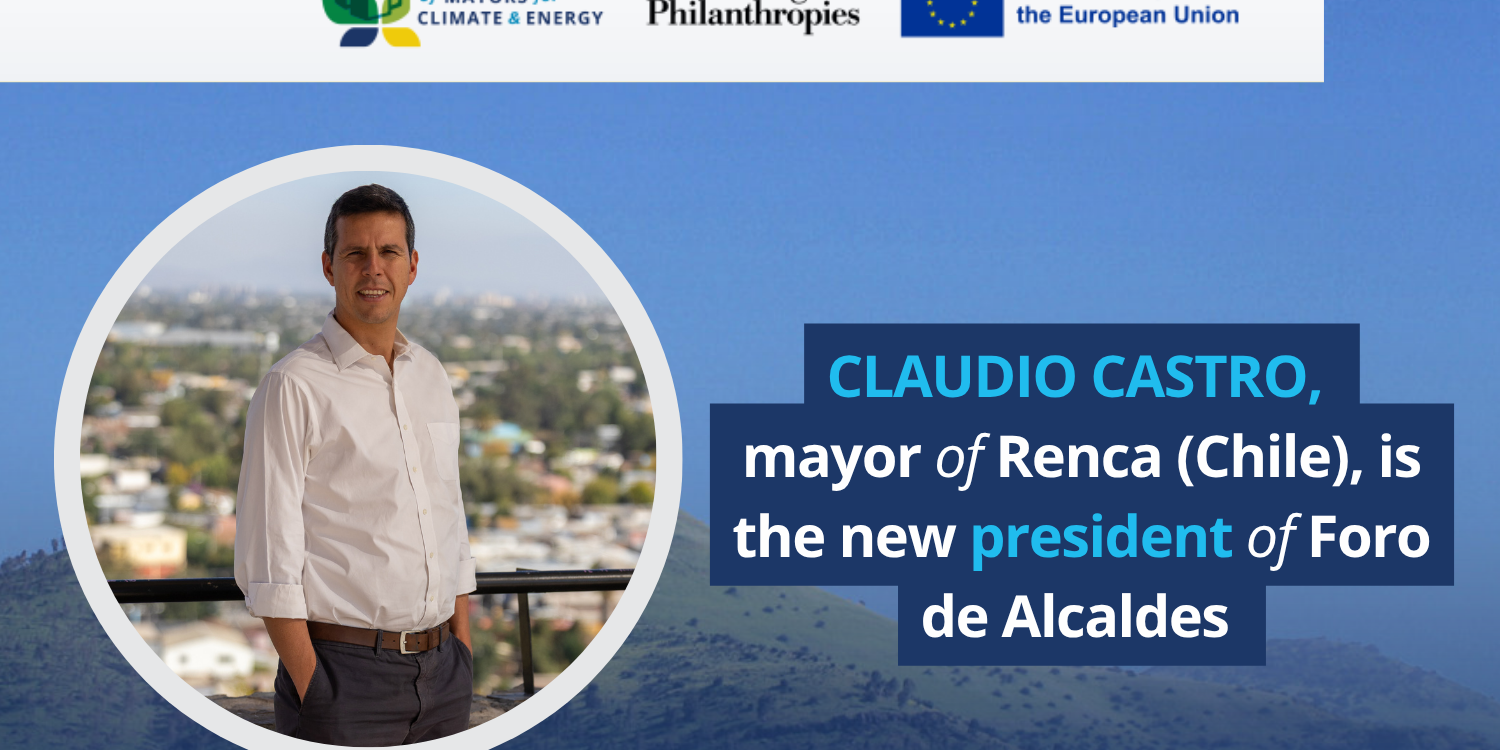
Claudio Castro, Mayor of Renca, assumes the presidency of the Mayors Forum of the Global Covenant of Mayors for Climate and Energy in Latin America
The Chilean mayor will lead a new phase of the Forum, focused on strengthening local climate action, regional cooperation and the implementation of urban solutions in response to the climate crisis.
Claudio Castro Salas, Mayor of Renca, Chile, assumed the presidency of the Mayors Forum of the Global Covenant of Mayors for Climate and Energy in Latin America (GCoM) in May. His election consolidates the leadership of one of the continent’s most recognized municipal leaders in the field of urban climate action and marks the beginning of a new phase for the Forum, which moves into 2026 with a renewed strategic agenda.
Castro has governed Renca since December 2016. A civil engineer from the Pontifical Catholic University of Chile and a Master in Public Administration from the London School of Economics, he has built his career at the intersection of public management, social development and community action.
For Castro, the local dimension is irreplaceable in the response to the climate crisis. “Being part of the Global Covenant of Mayors fills us with pride. This alliance is an incredible opportunity to exchange experiences and learn from the best environmental practices,” he said, referring to Renca’s recognition by GCoM.
The mayor has repeatedly emphasized that “the role of cities is fundamental” and that local governments need both explicit recognition from national governments and financing mechanisms that make the urban climate transition possible. At the head of the Forum, Castro will have the opportunity to bring this conviction to some of the main international spaces of the climate agenda.
The Forum enters a new phase
Created in October 2022, the Mayors Forum is GCoM’s political body in Latin America. Its mission is to amplify the voice and visibility of leading cities in climate action across the region. Since then, it has consolidated itself as a space for collaboration, leadership and advocacy around the local climate agenda.
In 2026, the Forum begins a new funding cycle aligned with GCoM’s Global Strategic Plan 2026–2028. The priorities defined for this period include deepening support for the implementation of climate action in the 16 member municipalities, with an emphasis on waste management, mobility and adaptation; strengthening regional ownership of GCoM in the Global South; and increasing the visibility of the alliance’s tenth anniversary.
The Forum will also seek to coordinate with Brazil’s Mutirão Program to replicate lessons learned on climate data, climate budgeting and multilevel coordination in Latin American cities.
Castro’s trajectory speaks directly to this new moment. Leading a municipality that does not have large-scale resources, the mayor has shown that it is possible to transform a territory through political organization, community participation and a long-term vision.
Renca, a municipality that became a benchmark
Renca is a municipality in the Metropolitan Region of Santiago, with around 165,000 inhabitants. In recent years, the city has significantly transformed its environmental trajectory: from a municipality with limited visibility in the field of sustainability, it has become one of the benchmarks in Chile and Latin America for local climate action.
Under Castro’s administration, Renca was the first municipality in the country to join the Race to Zero commitment and the ICLEI – Local Governments for Sustainability network, with the goal of achieving carbon neutrality by 2050.
The municipality has already planted more than 80,000 native trees on its hills, is developing a decarbonization roadmap structured around five pillars — water sustainability, energy sustainability, integrated waste management, sustainable mobility and nature-based solutions — and has been recognized by GCoM in the Mitigation and Adaptation categories.
In 2024, Renca also stood out in WWF’s international We Love Cities campaign, surpassing cities such as Paris and San Francisco.