From Costa Rica, Latin American climate leaders charted the course for 2026
COSTA RICA – Over the course of four days, the cities participating in the Mayors’ Forum of the Pact gathered in Costa Rica to demonstrate that the most effective climate action takes place where people live: in their local communities. These four days of dialogue, exchange of experiences, and technical visits contributed to the development of solutions focused on sustainable, resilient, and inclusive development, lessons that each member of the Forum will take back to their region.
Mayors’ Forum sets its course for 2026
Welcomed by the Costa Rican representatives at the Forum, Zeneida Chaves, mayor of Belén, and Erick Jiménez Valverde, mayor of Oreamuno, the program began on April 13 with the aim of learning about successful local initiatives. In Belén, urban gardens, pollinator gardens, the central park, and Los Andes Street, an urban corridor that integrates nature and active mobility, demonstrated how everyday infrastructure can become a concrete climate policy. They are also clear signs of the importance of coordination and participation from different sectors of the local community. In Oreamuno, the integration of socio-environmental aspects into the agricultural sector was evident at the Finca Modelo in Boquerón de Cipreses, dedicated to sustainable agriculture, confirming that the transition away from traditional models of production and consumption, as well as public-private partnerships, require urban innovation and new models of governance.
That same afternoon, the Mayors’ Forum met to discuss its work plan for 2026, moving in a single direction: to further advance the implementation of climate action in municipalities. In this context, a proposal was announced to provide technical assistance to the Forum’s member municipalities to help them develop climate action projects and connect them to funding sources and financial mechanisms. Throughout 2026, capacity-building efforts will focus on strengthening local governments’ ability to formulate climate projects in the three priority sectors: climate adaptation, waste management, and sustainable mobility.
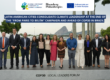
At the end of the meeting, mayors from the Forum signed a letter of support for the process of incorporating environmental management and climate change as mandatory pillars of local administration.
Territorial integration as a solution to local challenges
The following activities took place as part of the Third Ibero-American Congress of Metropolitan Areas, an event dedicated to developing joint solutions to challenges that transcend municipal boundaries and are strengthened through practical integration. The Congress was co-organized by the National Union of Local Governments (UNGL), with the Barcelona Metropolitan Area (AMB), the Córdoba Metropolitan Authority (Argentina), the National Council for Municipal Capacity Building (CONACAM), and the Covenant of Mayors.
Erick Jiménez, mayor of Oreamuno, representative of the Covenant, and member of the UNGL Board of Directors, opened the meeting with the message that new governance models are essential for the efficient use of resources and for the impact of municipal actions.
Carolina Urrutia, Director of Strategy and Implementation of Multilevel Partnerships at GCoM-C40, discussed the importance of multilevel partnerships and metropolitan areas for effective climate action, along with opportunities in this area and success stories of collaboration between different levels of government. In collaborative working sessions, Nicolás Cuesta, mayor of San Justo (Argentina), and Daniela Casanello, advisor to Vitacura (Chile), demonstrated that intermunicipal cooperation is already yielding concrete results on resilience issues.
The second day of the congress placed women’s leadership at the center. Three female mayors from the Forum led high-level discussions: Zeneida Chaves (Belén, Costa Rica) advocated for public services without borders between municipalities; Nancy Vizurraga (San Isidro, Peru) shared experiences with integrated mobility in Lima; and Janet Castagne (Coronel Portillo, Peru) presented joint solutions for waste management. Mayor Carlos Gutiérrez de La Estrella (Colombia) and Diego Rosero, Deputy Coordinator of International Financing for Manta (Ecuador), also shared real-world examples of sustainable mobility and reflections on the replicability of joint solutions.
“This meeting confirms that local challenges know no borders and that solutions must be developed in innovative ways at the local level. The climate transition is not a distant prospect; it is gaining momentum through the many projects carried out by leaders and communities committed to making progress and creating impact, as we saw in Costa Rica,” said Rebecca Borges, Coordinator of the Pact in Latin America.