2nd Technical Assistance Workshop of the Mayors Forum strengthened the development of bankable climate projects
Held on July 25 by the Global Covenant of Mayors for Climate and Energy in Latin America, the meeting guided municipal teams in turning climate solutions into projects with clear objectives, scope, indicators, impact and risk management.
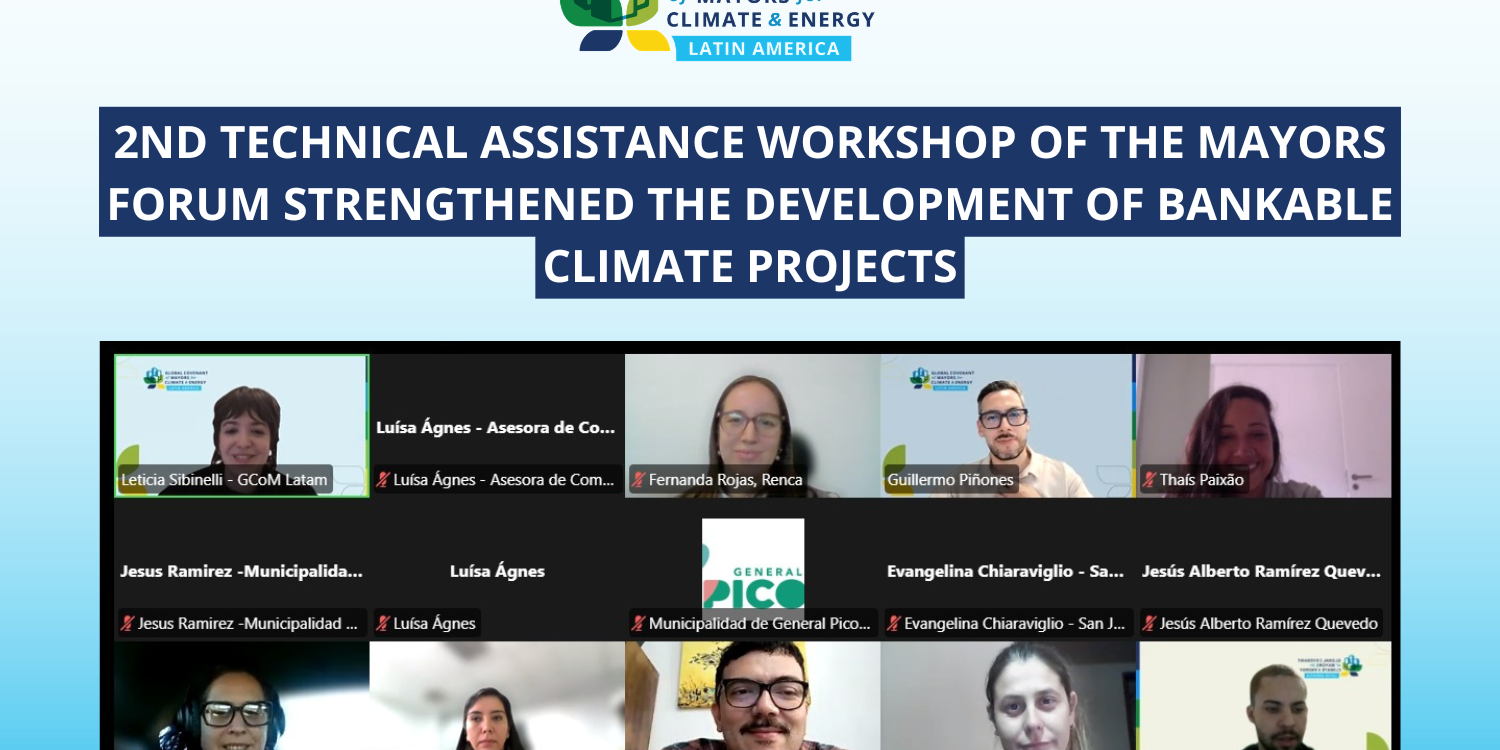
The Global Covenant of Mayors for Climate and Energy in Latin America (GCoM) held, on July 25, the 2nd Virtual Technical Assistance Workshop 2026 of the Mayors Forum, with the aim of strengthening the capacities of the 16 member cities of the Mayors Forum in the development of climate projects and access to finance.
The meeting brought together technical teams from Forum member municipalities and continued the technical assistance process launched in 2026, focused on developing concept notes that will make up an initial portfolio of climate projects in priority sectors for the region, such as adaptation, waste management and sustainable mobility.
The workshop was led by Letícia Sibinelli, institutional and data advisor at GCoM Latam, and Guillermo Piñones, climate finance specialist at GCoM Latam, who guided municipalities in structuring their proposals and identifying the elements needed for a climate solution to move toward a bankable project.
During the meeting, cities received guidance to advance in structuring Section B of their concept notes, dedicated to defining the solution and the project idea. The agenda addressed topics such as rationale, objectives, scope, expected impact, beneficiaries, co-benefits and risk analysis.
One of the main points addressed was the difference between a technical solution and a bankable project. “A climate solution needs to be translated into a clear, viable and measurable proposal, with objectives, indicators, responsibilities, a budget and an implementation logic,” said Guillermo Piñones.
From solution to project
The workshop reinforced that climate finance is granted to projects, and not only to ideas or technical solutions. For this reason, municipal proposals needed to be based on solid diagnostics, local evidence and a clear understanding of the root causes behind each climate problem.
The technical assistance also guided cities to avoid generalities and incorporate specific data on the territory, the beneficiary population, existing institutional capacities and the gaps that still need to be addressed in order to move toward implementation.
In this process, municipal teams analyzed how to prioritize solutions based on criteria such as climate effectiveness, technical feasibility, cost-benefit ratio, institutional capacity, social acceptance, co-benefits, bankability and time to impact.
Impact, benefits and risk management
The second part of the workshop was dedicated to strengthening the proposals. Teams discussed how to explain each project’s impact chain, from inputs and activities to outputs, outcomes and expected impacts.
The exercise also highlighted the importance of identifying direct and indirect beneficiaries, as well as the social, environmental, economic and institutional co-benefits of each intervention. This approach made it possible to connect climate action with issues such as equity, health, job creation, vulnerability reduction and improved quality of life in cities.
Another central topic was risk management. The workshop addressed the need for projects to identify technical, financial, climate, environmental, social, political, institutional, regulatory and legal risks.
“A climate fund does not finance only a technical solution. It finances the promised impact and the confidence that the municipality knows how to manage what may not go as planned,” said Guillermo Piñones.
Next steps in the technical assistance process
During the workshop, the Pact also presented the next steps in the technical assistance process. These included the consultation period for Section B, the publication of consolidated responses, sectoral meetings with specialists in adaptation, waste management and mobility, and the submission of project drafts by each municipality.
The 2026 technical assistance process seeks to support cities in gradually maturing their projects, from identifying climate challenges to building more robust proposals prepared to engage with funders.
Through this agenda, the Global Covenant of Mayors for Climate and Energy in Latin America reinforces its role as a platform for technical support, regional cooperation and coordination among cities. The objective is to help local climate ambition advance toward implementable projects, with measurable impact and concrete benefits for communities.