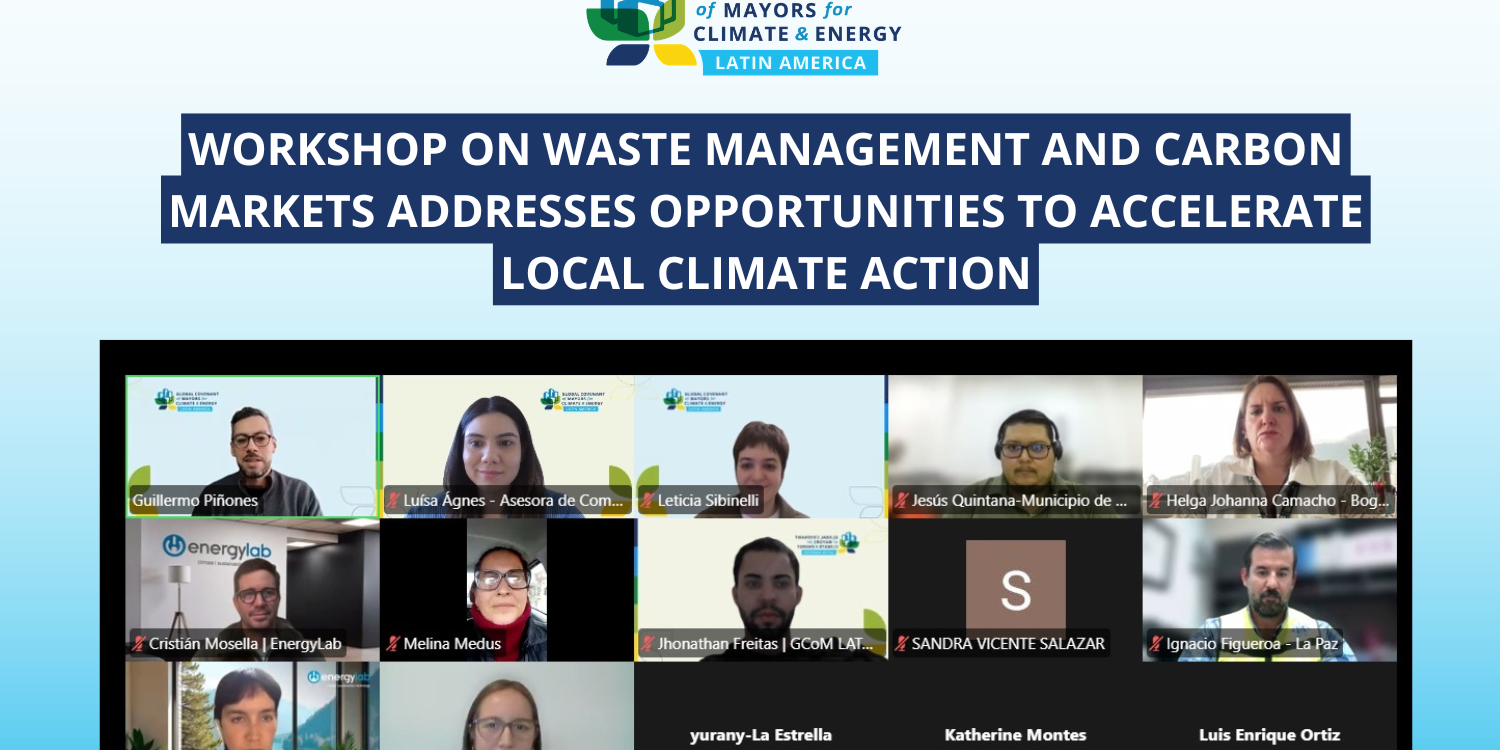
Workshop on waste management and carbon markets addresses opportunities to accelerate local climate action
Held on July 23, the meeting brought together cities from the Mayors Forum to discuss how to turn waste management into an opportunity for climate finance, energy generation and social impact
The Global Covenant of Mayors for Climate & Energy in Latin America (GCoM) held, on July 23, the workshop “Waste management: financing municipal solid waste projects through carbon markets,” as part of the technical assistance process aimed at cities of the Mayors Forum.
The meeting brought together representatives from Forum cities, GCoM specialists and technical experts to discuss how municipalities can turn solid waste management into a concrete opportunity for climate action, financing and urban innovation.
The agenda featured Guillermo Piñones, a climate finance advisor who coordinates GCoM Latin America’s technical assistance; Cristian Mosella, co-founder of Energy Lab and a carbon markets specialist; and Helga Johana Camacho, deputy director of Final Disposal at UAESP, Bogotá’s city government, who presented the experience of the Doña Juana landfill.
Throughout the workshop, participants addressed the potential of carbon pricing instruments, energy generation from biogas, methane emissions reduction, carbon standards, monitoring systems, and the mechanisms for turning waste projects into financially viable initiatives for cities.
Waste as a climate and financial asset
The solid waste sector represents one of the main opportunities for Latin American cities to advance their climate goals. The decomposition of organic waste in landfills generates methane, a greenhouse gas with high short-term warming potential.
During his remarks, Cristian Mosella explained the importance of acting on these emissions and highlighted the opportunities that municipal waste projects have to generate impact.
“Waste management is fundamental, and bringing these approaches into municipalities addresses an opportunity that is on the table. Methane is the ’emergency brake’ on rising temperatures; one ton of methane avoided is equivalent to up to 80 tons of CO2 in the short term,” said Mosella.
The specialist also stressed the importance of projects being aligned with standards linked to carbon pricing instruments and markets from their initial phase. As he explained, different accepted standards exist, so municipalities must determine from the outset which one best fits each type of initiative.
He also noted that a solid monitoring system is essential to ensure the credibility of results, measure emissions reductions, and enable access to carbon pricing instruments.
Bogotá’s experience with the Doña Juana landfill
The case presented during the workshop was the biogas project at the Doña Juana landfill in Bogotá. The experience was shared by Helga Johana Camacho, who detailed how the initiative contributed to meeting the Colombian capital’s climate goals.
During the presentation, it was explained that the project dates back to 2007, linked to a concession contract, and is part of Bogotá’s efforts to strengthen waste management, reduce environmental risks, and advance its climate commitments.
“Our project at the Doña Juana landfill allowed Bogotá’s capital district to meet 100% of its target under the Climate Action Plan. Today we have exceeded that target by 108%, contributing 42% of Colombia’s national target,” said Camacho.
Beyond its climate impact, the project also generates energy and social benefits. By harnessing the biogas produced at the landfill, Bogotá has moved toward electricity generation, strengthening a more stable source of revenue for the project.
Carbon credits with social impact
Bogotá’s experience also showed how resources generated from the sale of carbon credits can be directed toward social initiatives in communities near landfills. In the case of Doña Juana, revenues support initiatives aimed at Los Mochuelos, a community neighboring the landfill.
“We fund our entire social management program with resources from the sale of carbon credits. That money has a specific allocation for the Los Mochuelos community, next to the landfill, turning an environmental challenge into a direct social benefit,” Camacho noted.
The case reinforces that solid waste projects can go beyond climate mitigation. When well structured, they can contribute to improved quality of life, job creation, territorial compensation, and stronger ties with communities.
Carbon markets and municipal viability
Throughout the workshop, participants noted that carbon markets can be strategic instruments to support local governments in implementing climate projects. However, to access these opportunities, municipalities need to structure projects with consistent data, appropriate methodologies, clear governance, and monitoring capacity.
The discussion reinforced that waste management should not be seen merely as an operating cost for cities. With planning, technical assistance, and access to appropriate financial instruments, it can become an agenda for climate mitigation, energy transition, local value generation, and municipal innovation.