Held in Juiz de Fora, Brazil, the event brought together representatives from five countries to strengthen local capacities and advance towards caring, safe and resilient cities.
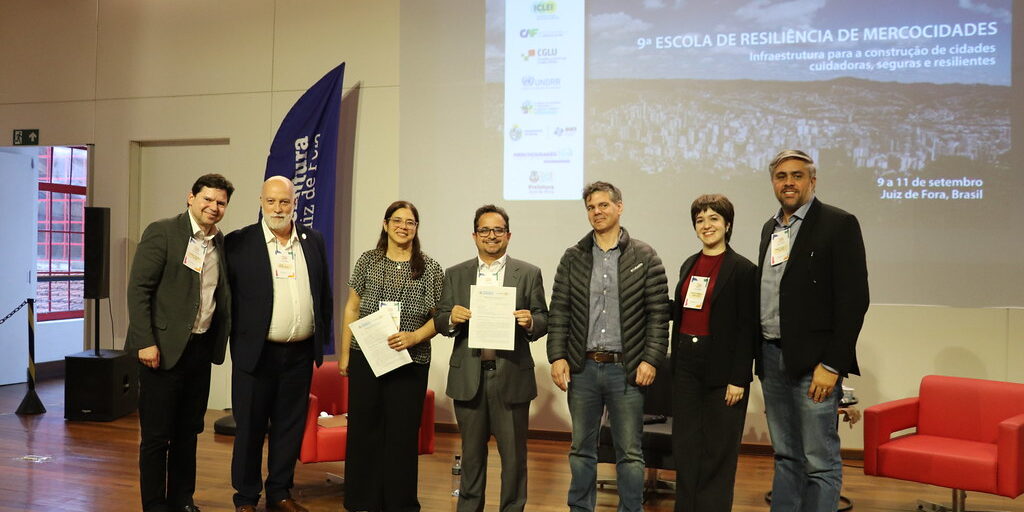
Adaptation finance and the development of climate solutions tailored to local realities were central to the participation of the Global Covenant of Mayors for Climate and Energy in Latin America (GCoM) in the 9th Mercociudades Resilience School, held from September 9 to 11, 2026, in Juiz de Fora, Brazil.
Organized by the Mercociudades South-South Cooperation Programme and the Resilient Cities Network (R-Cities), with support from GCoM and other partner organizations, the initiative brought together 27 local government representatives from Argentina, Brazil, Mexico, Paraguay and Uruguay.
Under the theme “Infrastructure for building caring, safe and resilient cities: Integrating a gender perspective into urban planning and management,” the event combined discussions, technical training and field experiences to strengthen municipalities’ capacity to respond to climate and urban risks.
Local solutions for building resilience
Letícia Sibinelli, Institutional and Data Advisor at GCoM Latin America, represented the Covenant on the thematic panel “Infrastructure for building caring, safe and resilient cities.” The panel also featured Javier Garduño, Latin America Director at R-Cities, and Rodrigo Perpétuo, Executive Secretary of ICLEI South America. Aline da Rocha Junqueira, Secretary for the Environment and Climate Change of the Municipality of Juiz de Fora, moderated the discussion.
The discussion addressed the challenges cities face in financing adaptation and resilience projects, as well as the need to develop viable proposals aligned with local priorities and backed by the capacity to implement them.
In her presentation, Sibinelli highlighted the diversity of local experiences and GCoM’s role in supporting climate action planning, implementation and monitoring. She also presented a schedule of training activities on climate risks, financing and energy access.
“Every city has a different starting point. Advancing adaptation therefore requires understanding local risks and needs, translating that assessment into viable projects and connecting planning with financing opportunities. At GCoM, we seek to support local governments throughout this process and facilitate the exchange of experiences so they can put their plans into practice,” said Sibinelli.
The panel also highlighted the relationship between infrastructure, care and vulnerability. Speakers emphasized the importance of coordinating solutions across different scales, from blocks and neighbourhoods to cities and metropolitan areas, and integrating gender and age perspectives into urban planning. This approach helps address the unequal impacts of climate risks on women, girls, boys, older people and other groups in vulnerable situations.
From technical training to local projects
The programme included technical training led by Javier Garduño, with support from Luisa Aucan of ICLEI South America and Letícia Sibinelli. During the session, participating cities examined their own projects through a resilience lens, identifying impacts, tensions and opportunities to improve implementation.
A technical visit to Morro do Imperador provided insight into the scale of the disaster that struck Juiz de Fora in February and the municipal government’s efforts to address its impacts and strengthen urban resilience. The experience connected the training content with the practical challenges of local governance.
As a next step, participants will submit a final assignment. A selection committee will assess the proposals and choose up to three cases to receive support through technical assistance and/or exchanges of experiences with cities across Latin America.