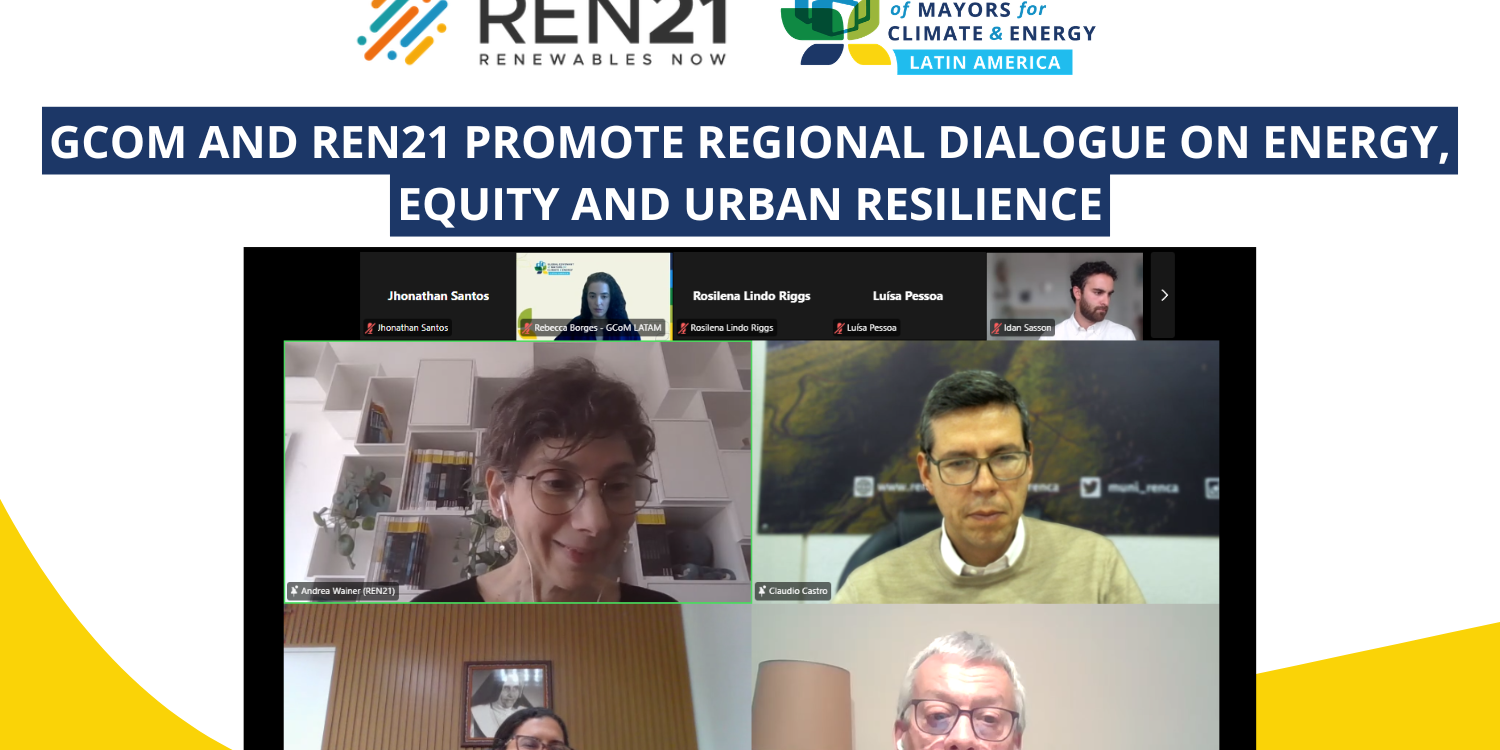
GCoM and REN21 promote regional dialogue on energy, equity and urban resilience
The virtual meeting brought together local leaders, municipal networks and experts to discuss how renewable energy can support a just, inclusive energy transition aligned with the needs of Latin American territories
The Global Covenant of Mayors for Climate and Energy in Latin America (GCoM) and REN21 held, on July 9, the regional dialogue “Energy as a driver of equity and urban resilience in Latin America”, with the aim of promoting exchange among local governments and experts on the role of cities in the energy transition.
The meeting was moderated by Andrea Wainer, from REN21, and featured Claudio Castro, mayor of Renca and president of the GCoM Mayors Forum in Latin America; Ana Paula Matos, deputy mayor of Salvador, Brazil, and member of the Forum; Rebecca Borges, GCoM LATAM coordinator; Rosilena Lindo, Senior Fellow at REN21 and former National Secretary of Energy of Panama; and Orlando Costa, coordinator of Energy-Efficient Buildings at Euroclima+ within the Argentine Network of Municipalities against Climate Change (RAMCC).
Throughout the conversation, participants emphasized that the energy transition is not only a technical challenge, but also a social, political and territorial one. Key topics included energy poverty, multilevel governance, access to data, climate finance, public transport electrification, citizen participation and the role of renewable energy in reducing inequalities.
During the discussion, participants also answered questions from the audience on public policies targeting the most vulnerable populations, citizen participation in energy decisions, rural electrification, financing for solar projects, energy poverty diagnostics and new metrics to assess the local value generated by renewable energy.
The meeting reinforced that the energy transition in Latin America must be understood as a deeply social and political process, one that requires data, cooperation, financing and solutions connected to the real needs of each territory.
Energy, territory and climate justice
The dialogue also introduced GCoM’s Energy Access and Energy Poverty Pillar (EAPP), which guides signatory cities in assessing, setting targets and reporting progress related to access to clean, safe, sustainable and affordable energy.
Opening remarks were delivered by Rebecca Borges, who framed the dialogue as part of a regional agenda aimed at bringing together perspectives, experiences and proposals on energy and local climate action.
“This space seeks to bring together local and regional voices to understand how cities can advance more just, resilient and inclusive energy solutions. The energy transition needs to be connected to the realities of territories and to the capacities of local governments,” Rebecca said.
During the introduction, Andrea Wainer presented REN21’s vision and highlighted the importance of expanding the debate on renewable energy beyond the technological dimension. REN21 is an international network dedicated to strengthening knowledge exchange, data and cooperation among governments, civil society, academia, the private sector and other actors to accelerate the transition toward energy systems based on renewable sources.
“The transition to renewable energy is already transforming markets and policies around the world, but the challenge is to ensure that this process generates concrete benefits for people, especially in the most vulnerable territories,” Andrea said.
Energy poverty, gender and multilevel governance
In her remarks, Rosilena Lindo addressed Latin America’s energy landscape through an integrated perspective linking development, gender, health and equity. She highlighted that energy poverty still directly affects rural communities, women and populations that depend on polluting fuels for cooking or lack adequate access to electricity.
“In communities where there is still not enough access to electricity, or where families depend on coal and polluting fuels for cooking, the energy transition is not an abstract debate. It is a condition for improving health, time, opportunities and quality of life, especially for rural women,” Rosilena said.
The former National Secretary of Energy of Panama also drew attention to the rise in electricity consumption associated with high temperatures, reinforcing the connection between climate change, energy demand and efficiency. According to her, rural energization must be considered part of a broader adaptation and resilience strategy.
Rosilena also advocated for public policies with a gender perspective and stronger coordination among national and subnational governments. “Multilevel governance is essential. Regions that still lack electricity or face precarious conditions of energy access must be at the center of public policies,” she said.
Salvador: energy transition with social justice
Drawing on Salvador’s experience, Ana Paula Matos presented city initiatives and reinforced that the energy transition must be approached through the lens of social and climate justice. The deputy mayor stated that clean energy solutions must respond to the historical inequalities that shape Latin American urban territories.
“To talk about the energy transition in Latin America is also to talk about social inequality. It is not only about changing the energy source, but about building solutions that reduce vulnerabilities and create opportunities for those who need them most,” Ana Paula said.
Examples shared included public policies implemented in Salvador in areas such as energy efficiency, solar energy and urban mobility. Ana Paula also mentioned the financial challenge of electrifying public transport, particularly due to the higher cost of electric buses, and highlighted the goal of moving toward a cleaner fleet in the coming decades.
The deputy mayor also emphasized the importance of research, technical cooperation and understanding the different financing frameworks that exist in each country. “Climate justice must guide decisions. For the transition to be viable, we need participation, multilevel governance, data and financing models that consider each city’s reality,” she said.
Renca: climate ambition with territorial impact
Claudio Castro, mayor of Renca and president of the GCoM Mayors Forum in Latin America, highlighted that the climate and energy crisis has a global impact, but is expressed concretely in territories. For him, in a deeply unequal region such as Latin America, the energy transition must be connected to the needs of communities and to the real implementation capacity of local governments.
“We are a deeply unequal continent. That is why climate ambition must be visible at the territorial level, in people’s lives and in the capacity of cities to build effective solutions,” Castro said.
The mayor also shared reflections from the experience of Renca, an intermediate city in Chile, and noted that municipalities need enabling conditions to move forward. Among them, he mentioned clear national policies, access to energy data, permanent technical assistance and direct or appropriate financing for local governments.
“To design local plans with effective targets and strategies, cities need data. But energy data is not always easy to access. That is one of the major challenges in moving from ambition to implementation,” he said.
Castro also highlighted the role of the Pact in supporting municipalities, especially in designing local plans and building technical capacities. According to him, small and medium-sized municipalities need ongoing support to structure projects and access financing opportunities.
GCoM and the leadership of local governments in the energy transition
To support local governments in addressing these challenges, GCoM has activated its Energy Access and Energy Poverty Pillar (EAPP), which guides committed cities in reporting information, identifying local needs and building strategies related to access to clean, safe, sustainable and affordable energy.
Within this framework, the dialogue sought to go beyond climate commitments and discuss concrete pathways for implementation in territories.
The importance of reporting under the energy pillar was also highlighted as a tool to improve municipal planning, identify local needs and bring cities closer to climate finance opportunities.
In this context, at the end of the meeting, GCoM LATAM announced that it will hold, in the second semester, a series of virtual workshops dedicated to the Energy Access and Energy Poverty Pillar. The proposal is to strengthen the technical capacities of GCoM signatory cities in Latin America, guide effective indicator reporting, disseminate good practices and share tools focused on distributed solar generation and the reduction of energy poverty.
With this agenda, GCoM and REN21 reinforce that energy is a central dimension of urban climate action. For Latin American cities, advancing renewable energy also means addressing inequalities, protecting vulnerable communities and building territories that are better prepared for the challenges of the future.