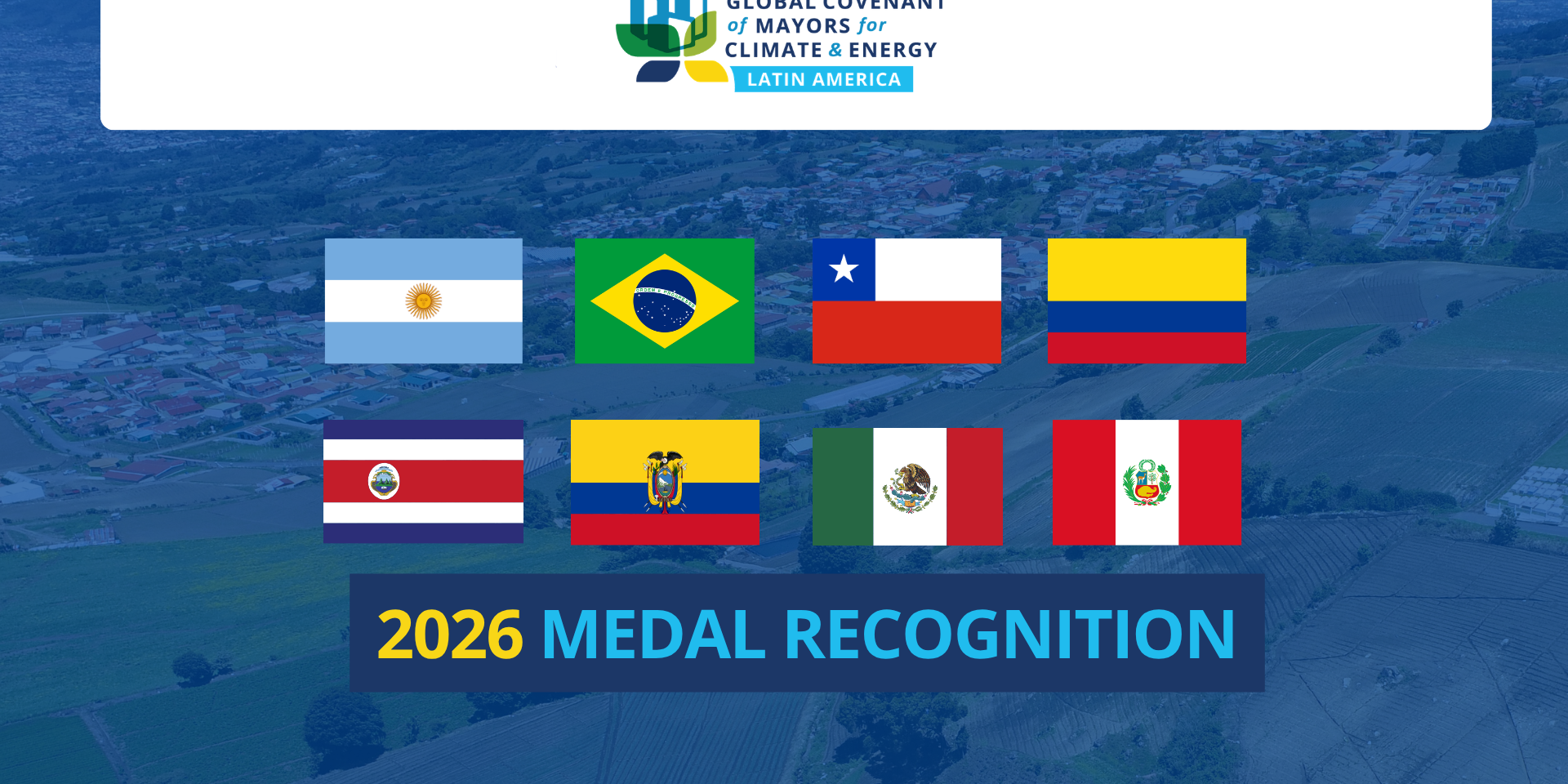
2026 Medals recognize Latin American cities’ progress in the Pact’s climate journey
In total, 59 cities from ten countries received 112 new medals for their progress in mitigation, adaptation, energy and compliance with GCoM commitments.
The Global Covenant of Mayors for Climate and Energy in Latin America (GCoM) presents the results of the 2026 Medals, a recognition system that gives visibility to the evolution of signatory cities in their climate journey.
The medals recognize local governments’ progress in the reporting, planning and implementation stages of their commitments across GCoM’s three pillars: mitigation, adaptation and energy. To receive this recognition, cities must report their progress through the CDP-ICLEI platform, following the GCoM Common Reporting Framework.
In 2026, cities from Argentina, Brazil, Chile, Colombia, Costa Rica, Ecuador, Guatemala, Mexico, Peru and Uruguay obtained, together, 112 new medals. Considering the main pillars, the recognitions included 28 mitigation medals, 62 adaptation medals and 20 energy medals. In addition, two cities achieved the Compliance Medal.
In total, 59 Latin American cities were recognized in this cycle, including capitals, intermediate cities and small municipalities that have been incorporating climate action into their local development, resilience and sustainability agendas.
The 2026 results add to a recent series of advances in the region and keep Latin America on a path of progress. Brazil and Argentina tied for first place in the number of new medals, followed by Chile and Mexico.
What the medals recognize
The GCoM Medal system makes it possible to track each city’s progress through concrete stages. In the mitigation pillar, the medals recognize actions related to greenhouse gas inventories, the definition of targets and the development of plans to reduce or avoid emissions.
In the adaptation pillar, the recognitions reflect municipalities’ progress in assessing climate risks and vulnerabilities, defining adaptation objectives and developing plans to address the impacts of climate change.
The energy pillar considers efforts related to assessments, targets and plans for access to clean, safe, sustainable and affordable energy, as well as the reduction of energy poverty.
In this cycle, the Compliance Medal was granted to cities that completed the two main pillars: mitigation and adaptation. The cities that achieved this recognition were Itapipoca, in Brazil, and Cuenca, in Ecuador.
Starting with the next cycle, cities will be required to complete all three pillars — adaptation, mitigation and energy — to receive the Compliance Medal. In other words, the inclusion of the energy pillar will become mandatory for a city to be considered compliant.
For Elise Abbes, GCoM Initiatives Engagement Advisor, the medals play an important role in recognizing the technical and political efforts of cities. “The 2026 Medals are not only a symbolic recognition. They are a way to give visibility to the work local governments have been doing to measure, plan and advance their climate commitments with greater transparency and consistency,” she said.
A region in motion
The 2026 results show a region making important progress in the local climate agenda. Adaptation was the pillar with the highest number of recognitions, with 62 new medals, highlighting the priority Latin American cities have given to risk management, urban resilience and the protection of their communities from the impacts of climate change.
Brazil and Argentina concentrated the largest number of new medals, with 27 recognitions each. Chile obtained 21 new medals, followed by Mexico, with 13. Ecuador registered 8; Colombia, 5; Costa Rica and Guatemala, 3 each; and Peru and Uruguay, 2 each.
Among the cities of the Mayors Forum that achieved new medals in 2026 are Salvador, which obtained the Energy — Energy Access and Poverty Assessment medal; Renca, with the Energy — Energy Access and Poverty Plan medal; Ambato, which earned the Mitigation — Inventory medal; Guadalajara, with the Energy — Energy Access and Poverty Targets medal; Oreamuno, with the Energy — Energy Access and Poverty Assessment medal; and Manta, also with the Energy — Energy Access and Poverty Assessment medal.
The balance also highlighted new signatory cities that joined the Pact the previous year and have already obtained recognitions, such as Aracruz and Crato, in Brazil, and Otavalo, in Ecuador.
For Rebecca Borges, GCoM LATAM Coordinator, the results reflect the strengthening of local capacities across the region. “Each medal represents a concrete step in a city’s climate journey. When we look at Latin America as a whole, we see local governments strengthening their capacities, improving their reporting and building an increasingly solid foundation to move from planning to implementation,” she said.
In addition to recognizing progress, the medals also help organize data, identify gaps and guide next steps. The report allows cities to gain visibility, track their evolution and better prepare to structure climate projects.
For Guillermo Piñones, climate finance specialist at GCoM Latam, the quality of reported information is decisive in bringing cities closer to new opportunities. “Climate finance requires evidence, consistency and clarity. When a city advances in inventories, risk assessments, targets and plans, it also strengthens its ability to structure more robust projects and demonstrate the impact it seeks to generate,” he said.
Argentina
Argentina obtained 27 new medals in 2026, distributed across 9 mitigation, 17 adaptation and 1 energy medal. In total, 7 Argentine cities were recognized: Córdoba, Villa de Merlo, Ceres, San José de la Esquina, Cañada Rosquín, El Trébol and San Salvador de Jujuy.
The country has 247 cities committed to GCoM and, in total records, including previous years, has already accumulated 589 medals, of which 285 correspond to mitigation, 246 to adaptation, 5 to energy and 53 to compliance.
Brazil
Brazil also obtained 27 new medals in 2026, distributed across 4 mitigation, 17 adaptation, 5 energy and 1 compliance medal. The country registered 18 awarded cities: Salvador, Belo Horizonte, Recife, Campinas, Santo André, Cuiabá, Florianópolis, Rio Branco, Capivari, Tangará da Serra, Cáceres, Goiânia, Contagem, Cametá, Itapipoca, Itabirito, Aracruz and Crato.
Among the new medals, Salvador stands out. The city is part of the Pact’s Mayors Forum in Latin America and earned the Energy — Energy Access and Poverty Assessment recognition.
Brazil has 175 cities committed to GCoM. In total records, including previous years, the country has 231 medals, with 74 in mitigation, 124 in adaptation, 23 in energy and 10 in compliance.
Chile
Chile reached 21 new medals in 2026, with 5 mitigation, 10 adaptation and 6 energy medals. The 9 awarded cities were Temuco, Cerro Navia, Maipú, San Bernardo, Algarrobo, Punta Arenas, El Quisco, Lautaro and Renca.
Renca, a member of the GCoM Mayors Forum in Latin America, earned the Energy — Energy Access and Poverty Plan medal.
The country has 32 cities committed to GCoM and, in total records, including previous years, has accumulated 112 medals, distributed across 30 in mitigation, 57 in adaptation, 20 in energy and 5 in compliance.
Colombia
Colombia obtained 5 new medals in 2026, distributed across 2 mitigation, 2 adaptation and 1 energy medal. The 3 awarded cities were Girardota, Montería and Barranquilla.
The country has 56 cities committed to GCoM and, in total records, including previous years, has 93 medals, with 31 in mitigation, 49 in adaptation, 8 in energy and 5 in compliance.
Costa Rica
Costa Rica obtained 3 new medals in 2026, with 1 mitigation, 1 adaptation and 1 energy medal. The awarded cities were Oreamuno and Alajuela.
Oreamuno, a member of the GCoM Mayors Forum in Latin America, earned the Energy — Energy Access and Poverty Assessment medal.
The country has 28 cities committed to GCoM and, in total records, including previous years, has 101 medals, distributed across 37 in mitigation, 46 in adaptation, 11 in energy and 7 in compliance.
Ecuador
Ecuador registered 8 new medals in 2026, distributed across 3 mitigation, 4 adaptation and 1 energy medal. In addition, Cuenca achieved the Compliance Medal. The recognized cities were Cuenca, Sucre, Manta, Ambato, Montecristi, Salinas and Otavalo.
Ambato earned the Mitigation — Inventory medal, and Manta earned the Energy — Energy Access and Poverty Assessment medal. Both are member cities of the GCoM Mayors Forum in Latin America.
The country has 20 cities committed to GCoM and, in total records, including previous years, reached 48 medals, with 15 in mitigation, 27 in adaptation, 3 in energy and 3 in compliance.
Mexico
Mexico obtained 13 new medals in 2026, with 3 mitigation, 8 adaptation and 2 energy medals. The 7 awarded cities were Chihuahua, San Luis Potosí, Guadalajara, Delicias, Ahome, Torreón and Salamanca.
Guadalajara, a member of the GCoM Mayors Forum in Latin America, earned the Energy — Energy Access and Poverty Targets medal.
The country has 119 cities committed to GCoM and, in total records, including previous years, reached 145 medals, distributed across 43 in mitigation, 79 in adaptation, 15 in energy and 8 in compliance.
Peru
Peru obtained 2 new medals in 2026, distributed across 1 adaptation and 1 energy medal. The awarded cities were Lima and Chiclayo.
The country has 53 cities committed to GCoM and, in total records, including previous years, reached 71 medals, with 17 in mitigation, 47 in adaptation, 4 in energy and 3 in compliance.
Uruguay
Uruguay obtained 2 new medals in 2026, distributed across 1 mitigation and 1 energy medal. The awarded cities were Montevideo and Canelones. The result incorporates the country into the regional balance of progress recognized by the GCoM Medal system.
Guatemala
Guatemala obtained 3 new medals in 2026, distributed across 2 adaptation and 1 energy medal. The awarded cities were La Democracia and Escuintla. Its inclusion in the regional balance reinforces the expansion of Central American cities’ climate journey within the Pact.
Recognizing progress to accelerate implementation
The 2026 Medals show that Latin American cities are advancing through different stages of their climate journey, from developing inventories and risk assessments to defining targets, plans and actions related to energy access.
By recognizing this progress, the Pact seeks to give greater visibility to the technical work carried out by municipalities, strengthen cooperation among cities and guide next steps so that climate commitments can become concrete actions.
With these results, the Global Covenant of Mayors for Climate and Energy reaffirms the leading role of Latin American local governments in responding to the climate crisis and building more resilient, sustainable and inclusive territories.