CCI25 in Córdoba: Global Covenant of Mayors Drives Inclusive, Innovative and Scalable Local Climate Solutions
From July 1 to 3, 2025, the Global Covenant of Mayors for Climate and Energy (GCoM) actively participated in the International Climate Conference “Latin American Commitment” (CCI25), held in Córdoba, Argentina. As Latin America and the world prepare for COP30 in Belém, Brazil, the Covenant highlighted the essential role of cities and regions in driving ambitious, inclusive, and financeable climate solutions. Through high-level sessions on gender equity, climate finance, artificial intelligence, and innovation partnerships, the GCoM reaffirmed its commitment to empowering local governments and advancing a just and effective global climate transition.
Gender and Inclusion at the Heart of Climate Action
On the first day of the event, GCoM led two plenary sessions focused on gender and inclusion, alongside UN Women, Instituto Alziras, ICLEI Argentina, and RIL. These sessions addressed the intersection of climate impacts with systemic inequalities that disproportionately affect women, girls, and marginalized communities. Participants presented real-world examples and innovative public policies from different cities that are leading inclusive, community-based responses to climate challenges. Carolina Basualdo, Mayor of Despeñaderos in Argentina and member of GCoM’s Board of Directors, emphasized the urgency of feminist and justice-based climate action, stating, “There’s no climate action if it’s not inclusive, feminist, and just. Women are more exposed to the consequences of climate change, but they are also leading change with innovative solutions from the ground up. This session was proof of that: committed women in their communities, with their knowledge and actions, who inspire continued climate efforts.”
The participants were Victoria Flores, Minister of Environment of the Province of Córdoba (Argentina); Marcia Conrado, Mayor of Serra Talhada (Brazil) and Vice President for Gender at the National Front of Mayors of Brazil (FNP); Claudia Martínez, Secretary for Women in the Government of Córdoba (Argentina); Cida Falabella, Councilwoman of Belo Horizonte (Brazil); Fernanda Lordelo, Secretary for Women, Children, and Youth of Salvador (Brazil); Sandra Patricia Carabalí, President of the Youth Network of Cauca (REDEJOCA) in Colombia; Nidya Pesántez, UN Women Representative in Bolivia; Illiza Sa’aduddin Djamal, Mayor of Banda Aceh (Indonesia); Nadia Gush, Deputy Mayor of Kalush (Ukraine); Ibel Diarte from the Gran Chaco Foundation; Laura Marrero from the Ministry of Environment of Uruguay; Anabela Aldaz, Program Coordinator at UN Women in Uruguay; and Liliana Miranda, Lead Author of the IPCC and representative of the Cities for Life Forum in Peru.
The sessions brought together a powerful and diverse group of women leaders from government, civil society, and academia, including public officials from Argentina, Brazil, Colombia, Bolivia, Indonesia, Ukraine, Uruguay, and Peru. Their voices underscored the importance of representation and the need to integrate care, justice, and equity into climate solutions.
During the discussions, Asma Jhina, GCoM’s Senior Advisor on Urban Climate Finance and Inclusion, officially launched the Gender and Inclusion Toolkit, a practical resource designed to help cities incorporate inclusive principles in the design, budgeting, and implementation of climate policies. She noted that cities are already doing remarkable work to include gender perspectives in their climate plans, and the toolkit offers step-by-step tools to support transformational change rooted in intersectional justice.
Advancing Urban Innovation Through the Innovate4Cities Marketplace
On July 2, GCoM and UN-Habitat hosted the Innovate4Cities Marketplace, a dynamic space that connected local governments with researchers, businesses, and innovators to co-create climate solutions tailored to local needs. The event included the launch of the Cities and Local Governments Sector Brief, identifying key knowledge gaps and action priorities in the region. Thirteen cities from Argentina, Brazil, Chile, Costa Rica, Ecuador, and Peru shared their primary climate challenges, followed by innovation pitch sessions and roundtables on artificial intelligence, financing, biodiversity, and the circular economy. According to Benjamin Jance IV, Director of Innovation, Research, and Impact at GCoM, “The Marketplace demonstrated that while local governments are taking concrete steps to meet community needs, significant gaps in knowledge, capacity, and financing persist. By connecting practice, science, and policy, he explained, the Covenant is helping to lay the groundwork for evidence-based solutions that can scale rapidly, create jobs, improve health, and safeguard livelihoods”.
Technical Visit to Despeñaderos: Local Climate Action and Gender Inclusion in Practice
As part of the official agenda, participants visited the city of Despeñaderos, guided by the Mayor Carolina Basualdo, to observe inclusive and locally led climate projects. These included “Despeñaderos Florece”, which is transforming an old quarry into a space for agroecological flower production, sustainable tourism, and environmental education; a textile recycling and women’s empowerment workshop called “Mujeres Resilientes y Corazones que Cuidan”; and the biodiesel production initiative “Grupo Dos Ríos”, which operates through a public-private partnership. Another highlight was the newly inaugurated recycled sports field at Club Juventud Alianza, funded by Bloomberg Philanthropies’ Youth Climate Action Fund, of which Despeñaderos is one of 100 global recipient cities. These initiatives demonstrated how community-driven climate actions can deliver concrete environmental, social, and economic benefits.
Mayors’ Forum Meeting: Advancing a Shared Local Climate Agenda Toward COP30
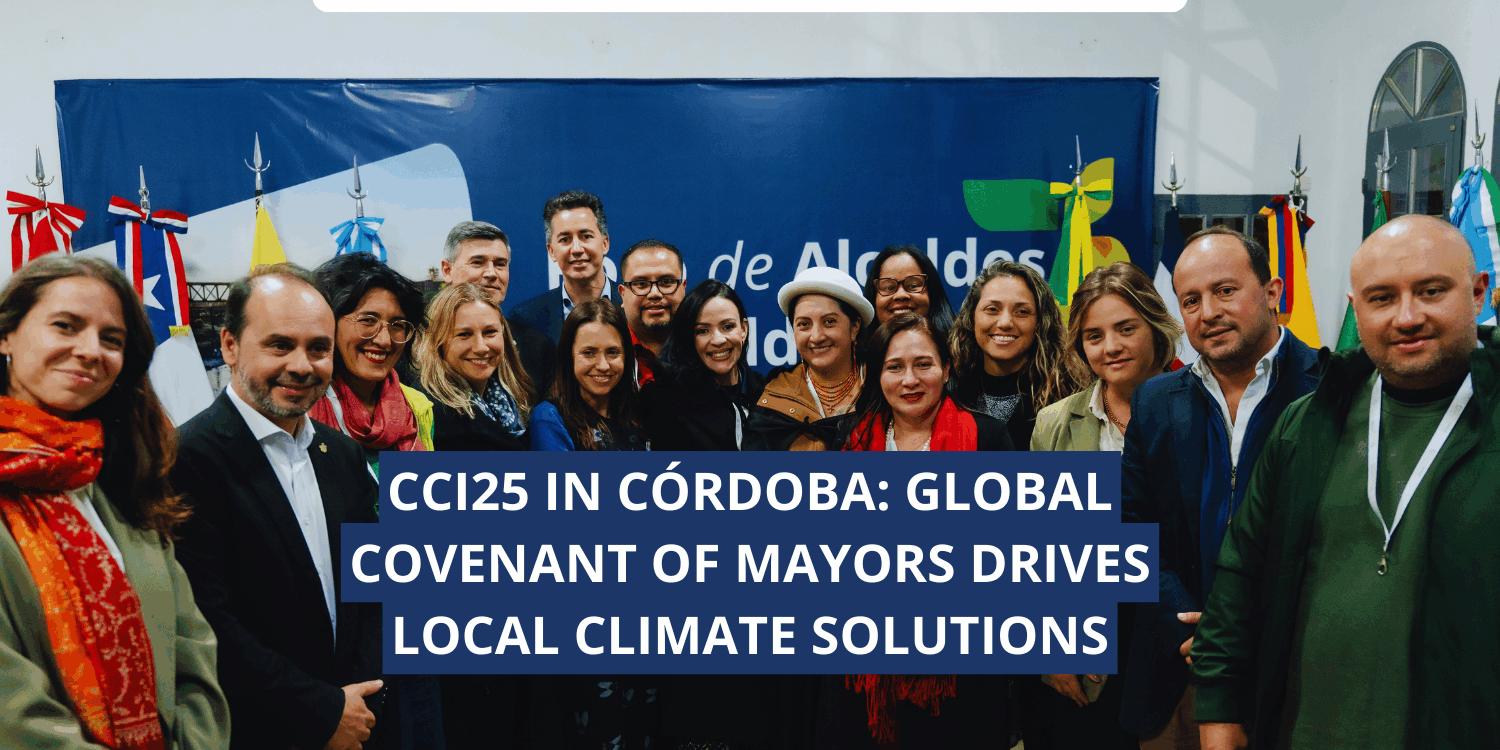
After the technical visit, members of the GCoM Mayors’ Forum in Latin America held a strategic meeting in Despeñaderos to align the region’s local climate agenda ahead of COP30. The session was chaired by Mayor Carolina Basualdo, who currently leads the Forum and represents Latin America on GCoM’s Global Board of Directors. This governance body brings together 13 mayors from GCoM signatory cities across eight countries, leading concrete climate actions and serving as regional spokespersons in multilateral spaces. Among the participants were Erick Jiménez, Mayor of Oreamuno (Costa Rica); Diana Caiza, Mayor of Ambato (Ecuador); Marcia Conrado, Mayor of Serra Talhada (Brazil); Nicolás Cuesta, Mayor of San Justo (Argentina); Janeth Vásquez, Mayor of Coronel Portillo (Peru); Pamela Torres, Secretary of Environment of Renca (Chile); Carlos Andrés Correa Mesa, Secretary of Environment of La Estrella (Colombia); Daniela Casanello, Advisor on Green Areas and Sustainability in Vitacura (Chile); Fernanda Lordelo, Secretary for Women, Children, and Youth in Salvador (Brazil); and Dulcehe Jiménez, Secretary of Environment of Belén (Costa Rica). Special guests included Manuel Calvo, Minister of Government of the Province of Córdoba, and Daniel Passerini, Mayor of the City of Córdoba. Participants reaffirmed their commitment to an ambitious and inclusive regional agenda, adapted to the realities of Latin American cities and aligned with the goals of COP30 in Belém.
Scaling Artificial Intelligence for City-Led Climate Action
On July 3, GCoM hosted a panel discussion on artificial intelligence and climate action, which brought together digital transformation experts, municipal leaders, and innovation labs to explore how AI and digital tools can help cities model scenarios, assess risks, and make evidence-based decisions. Highlighting the results of GCoM’s first AI for Urban Climate Action Hackathon—focused on urban heat island effects—Belo Horizonte presented pioneering work using AI to guide urban planning. The session also featured the 2025 edition of the Hackathon, which is currently open for submissions, with finalists set to present their proposals at New York Climate Week this September. The panel also addressed concerns surrounding AI, such as job displacement and high energy consumption, while presenting real-world applications of AI to accelerate local climate action. It closed with a call to democratize access to data and ensure that digital innovation supports equity and resilience in cities.
Also on July 3, GCoM—through its Invest4Cities initiative, in partnership with the GCoM-Gap Fund and Bankable Cities—hosted a session on scaling urban climate finance. Titled “Learning from Practice,” the session brought together multilateral development banks, subnational governments, and technical experts to discuss the challenges and opportunities involved in preparing climate projects and the role of accelerators in the financing process. Real cases from Chile, Argentina, and Brazil were presented, including green infrastructure and distributed solar energy projects, supported in their early stages by technical assistance from GCoM and its partners. The session highlighted the importance of strengthening technical readiness as a critical step in accessing climate finance and advancing the implementation of local solutions.