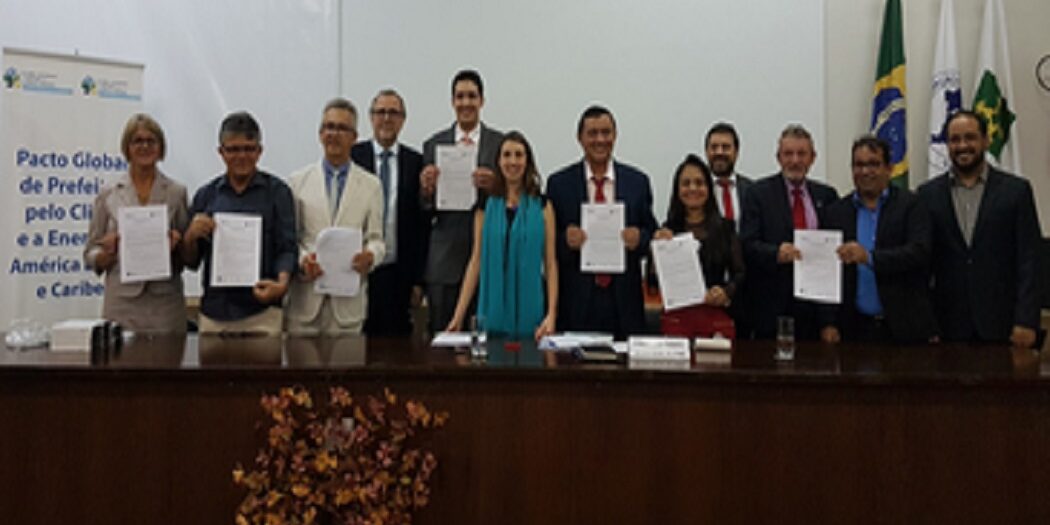
Nine Brazilian cities signed the accession to the Global Covenant of Mayors for Climate and Energy (GCoM) in Brasília (Brazil), the largest global alliance of cities committed to combating global warming, which already has 9,149 member cities.
Itacoatiara (AM), Nova Santa Rita (RS), Alexânia (GO), Indiaroba (SE), Serra Talhada (PE), São Cristóvão (SE), Lauro de Freitas (BA), Camocim (CE), and Juruti (PA) are the localities that committed to promoting local actions in the face of the phenomenon and being present in international discussions on sustainability.
The mayor of Camocim, Mônica Gomes Aguiar, assured that “being part of the Covenant means being able to exchange experiences with the most advanced municipalities in discussions on sustainable development” and invited different actors to “invest so that cities can develop sustainably.”
As part of this global movement, cities must now follow a roadmap to implement actions in their municipality over the next 3 years, such as preparing greenhouse gas inventories, vulnerability analysis, and climate and energy action plans. For this, cities will have access to training and technical support from organizations such as ICLEI – Local Governments for Sustainability, the Brazilian Association of Municipalities, the National Front of Mayors, the National Confederation of Municipalities, and GCom-LAC, to develop these steps next year.
The signing ceremony for the nine cities took place during the Panel on the SDGs in municipalities, promoted by the Brazilian Association of Municipalities (ABM), on November 27, in the capital of Brazil. The panel was composed of the Minister Counselor of the European Union in Brazil, Thierry Dudermel, the Executive Director of ABM, Eduardo Tadeu Pereira, and the Coordinator of Institutional Relations and Communication of ICLEI South America, the organization that chairs the National Advisory Committee of the Covenant in Brazil, Daniela Ades.
The mayor of São Leopoldo, in Rio Grande do Sul, and President of the Brazilian Association of Municipalities, Ary Vanazzi, guaranteed that “we are working to help municipalities prepare better, know each other better, and seek the application of policies related to the SDGs in their populations.” Vanazzi added, moreover, that ABM has taken the “commitment to our mayors, so that they are included, trained, and also defend the Covenant of Mayors, which contributes to a better coexistence in the construction of our cities.”
The panel addressed the implementation of the SDGs in municipalities, focusing on the experience of the Sustainable Development Partnership project.
About the Global Covenant of Mayors for Climate and Energy
The Global Covenant of Mayors for Climate and Energy formally brings together the Compact of Mayors and the Covenant of Mayors of the European Union, the two main city initiatives to help cities and local governments in their transition to a low-carbon economy and demonstrate their global impact. Led by the Special Envoy of the Secretary-General for Cities and Climate Change of the United Nations, Michael R. Bloomberg, and the Vice President of the European Commission, Maroš Šefčovič, the coalition comprises more than 9,149 cities on 6 continents and 120 countries, representing more than 700 million people or 10% of the world’s population. Get more information at http://pactodealcaldes-la.eu. The Global Covenant of Mayors for Climate and Energy in Latin America and the Caribbean is the project working to establish the Global Covenant in the region.