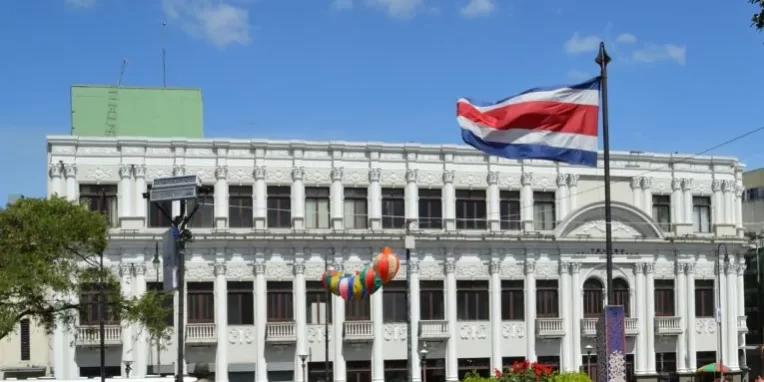
An online event brought together 22 municipalities and the national coordinators of the Global Covenant of Mayors for Climate and Energy (GCoM) in Costa Rica on November 10 to present the results and progress achieved in climate actions in 2020.
Regarding the current environmental challenges, the Deputy Rector of the National University, Marianela Rojas, emphasized that “today we are in a race against time” to prevent climate changes and their effects on cities. “Recently, and very sensitized, we have witnessed once again the impacts deeply felt in communities in our country and especially the suffering of the population from the devastating consequences of this phenomenon,” highlighted Rojas.
From this perspective, the President of the Union of Local Governments (UNGL), Johnny Araya, believes that every day there is more evidence of the catastrophic consequences that climate change is causing in the world and the dangers it poses to human life on the planet. In this scenario, Araya recalls that the central objective of the Covenant is to empower mayors and cities in climate actions, and the work of governments is crucial.
“It is an effort in which we understand that local governments are vital protagonists to make these objectives a reality. We have to build a solid agenda on different environmental issues,” defended Araya, who is also the Mayor of San José, president of the Latin American Federation of Cities, Municipalities, and Associations of Local Governments (FLACMA), and co-president of United Cities and Local Governments (UCLG).
Results of the Covenant in Costa Rica
In Costa Rica, the Covenant has provided training and technical assistance for local governments to develop their Climate Action Plans (SECAP, for its acronym in English). The process benefiting the country started in 2018 and will conclude in November 2020.
The main results of the project in 2020 are summarized in the development of 3 products: a portfolio that compiles the experience of the cantons of Costa Rica in adaptation, a virtual course on basic aspects of adaptation to improve the knowledge of technicians on the subject, and support for 6 municipalities to integrate their climate action plan, selecting those municipalities that have made greater progress, including having their Greenhouse Gas Inventory, as part of their participation in the Country Carbon Neutrality Cantonal Program (PPCNC) and actions related to adaptation.
National Coordinators are the organizations through which cities can engage with the Covenant, in Costa Rica the coordination is carried out by the National Union of Local Governments (UNGL), the Climate Change Directorate (DCC-MINAE), and the National University.
In this process, municipalities reviewed the results obtained for the PPCNC, conducted a basic assessment of climate hazards and vulnerabilities, and identified actions related to adaptation carried out by different areas of the municipality, specifying actions and objectives to comply with monitoring and control of progress reporting. Each action is accompanied by information about those responsible for execution, the timeframe, its relationship with the canton’s instruments, and its financing. These 6 municipalities have also committed to updating these plans in 2021-2022 when the Resilient Territories Plan A Program publishes a series of tools to complete local planning on adaptation.
In Costa Rica, Belén and San José received medals for the 2019 report. It is expected that the medal count will increase in 2020, meanwhile, more municipalities have signed their commitment, made significant progress, and submitted their reports.
There are already 22 member municipalities of the Global Covenant of Mayors in Costa Rica.

See below the words of Eida Arce from UNGL about the event: