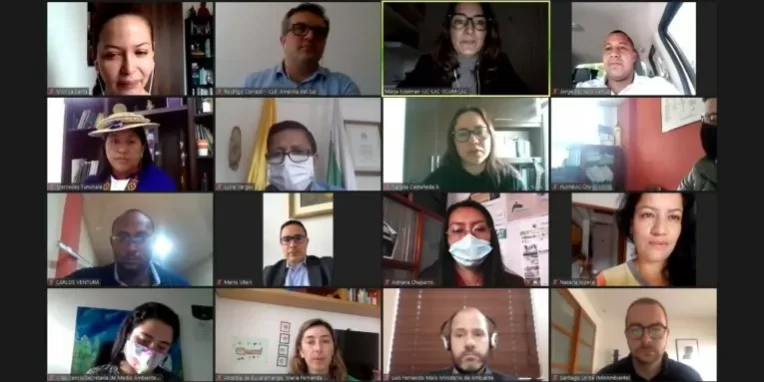
Today (28), the commitment declaration event took place for Colombian cities signatories of the Global Covenant of Mayors for Climate and Energy in Latin America and the Caribbean (GCoM LAC).
“It is a very important milestone in the history of GCoM in Colombia. We are confident that we are building a solid path in the country, uniting efforts to strengthen local climate action,” highlighted Marja Edelman, the coordinator of the Global Covenant of Mayors for Climate and Energy in Latin America and the Caribbean. She also emphasized that this work is possible thanks to the institutional commitment of key actors such as the European Union delegation in Colombia, the Ministry of Environment and Sustainable Development, the Colombian Association of Capital Cities (Asocapitales), the Colombian Federation of Municipalities (FCM), WWF, ICLEI, and especially the mayors who have participated by joining the Covenant or reaffirming their commitment.
In this regard, the Executive Secretary of ICLEI South America, Rodrigo Perpétuo, also emphasized the importance of collaboration between these institutions to facilitate this significant gathering: “With this event, we strengthen the working relationship between ICLEI, Asocapitales, and the Colombian Federation of Municipalities, demonstrating the unity of entities linked to the Covenant, with the support of the European Union and the Colombian government driving this agenda,” expressed Perpétuo.
During the meeting, the main objectives and goals of the Covenant were presented, as well as the key commitments assumed by participating cities: reducing greenhouse gas emissions, identifying and adapting to climate change-related risks, and increasing access to clean and affordable energy.
The European Union Ambassador in Colombia, Patricia Llombart, highlighted that cities should be considered fundamental in achieving all Sustainable Development Goals and implementing the Green Deal. “We are pleased that Colombia is joining the Covenant because local authorities are pioneers in introducing the transformations and changes necessary to combat climate change,” she emphasized.
The Covenant has over 10,000 local governments committed in more than 135 countries worldwide, representing nearly 10% of the global population. This network is possible thanks to the efforts of many fronts, as highlighted by the coordinator of ICLEI Colombia, Mónica Santa, sharing her country’s experience.
“The great gain from this process is the theme of partnerships. It has not ended yet, but in this phase, we have been able to create an operational partnership that is working on the go. We have managed to bring practically all the strategic actors of the Covenant in Colombia to the table, and that bodes well for successful actions in the territory in the future,” said Mónica.
The Covenant initiative aims to reduce the unavoidable impacts of climate change on municipalities, causing damage to infrastructure and directly affecting populations, while facilitating access to sustainable energy. According to the Executive Director of the Colombian Federation of Municipalities, Gilberto Toro Giraldo, “local government alliances are crucial for influencing impactful climate actions that can mitigate these problems.”
It is from this perspective of a shared long-term vision that the interconnected challenges of mitigation, adaptation to climate change, and access to secure, sustainable, and affordable energy can be overcome. As emphasized by the Director of Government Relations and International Affairs of WWF Colombia, María Ximenes Barrera, “the contribution that subnational actors are making to fulfill the Paris Agreement is very important.”
In practical terms, local governments committed to the GCoM undertake commitments such as developing greenhouse gas emissions inventories, climate risk assessments, and vulnerability assessments, as well as setting goals and action plans that include both mitigation and adaptation.
In this regard, acknowledging the importance of public policies, the Deputy Minister of the Ministry of Environment and Sustainable Development, Nicolás Galarza Sánchez, stated, “I am very happy to participate in this Covenant commitment declaration, reaffirming Colombia’s commitment to public policies on climate change.”
Representatives from more than 30 municipalities attended the event, where the Executive Director of Asocapitales, Luz María Zapata, reaffirmed the commitment of cities that have made significant strides in building municipal greenhouse gas inventories, assessing climate risk, and developing climate action plans with the support of the European Union, IUC, and ICLEI. “Today, we have achieved that 13 capital cities are part of this great alliance. Six cities committed to the Covenant during the year 2020: Villavicencio, Pasto, Manizales, Pereira, Riohacha, and Quibdó,” added Luz María Zapata, the executive director of Asocapitales.
Cities such as Pereira, Riohacha, Quibdó, San Juan de Pasto, Villavicencio, Gámeza, Beteitiva, Bucaramanga, Miranda, Monguí, Busbanzá, Chivatá, Corrales, Encino, Floresta, Manizales, Santa Helena del Opón, Morelia, Mongua, Bahía Solano, Gámeza, La Estrella, Cumbitara, Ocamonte, Solano, Caldas, Riosucio (Caldas), Tópaga, Cartagena de Indias, Cicuco, Silvia, San José de Caldas, Briceño, and Macanal also participated in the event.
The event was organized by the Global Covenant of Mayors in Latin America and the Caribbean, funded by the International Urban Cooperation Program for Latin America and the Caribbean of the European Commission (IUC-LAC), and implemented in Colombia by ICLEI South America, with the support of Asocapitales and the Colombian Federation of Municipalities.