According to reports from international organizations, the Nationally Determined Contributions (NDCs) voluntarily undertaken by countries as part of the Conference of the Parties after the signing of the Paris Agreement continue to be insufficient to limit the global temperature increase to 1.5 degrees by 2050, a goal outlined in the Paris Agreement.
To achieve this objective, more than 9,000 cities worldwide are engaged in the fight against climate change under the Global Covenant of Mayors for Climate and Energy (GCoM), the largest global alliance of cities and local governments voluntarily committed to slowing down global warming. Seventy of these cities are already developing long-term strategies to reduce emissions by 2050.
An example of commitment to fulfilling the agreements is that of the cities of Buenos Aires and Quito, which have recently called for additional efforts by nations, with the support of local and regional actors, to more effectively combat climate change.
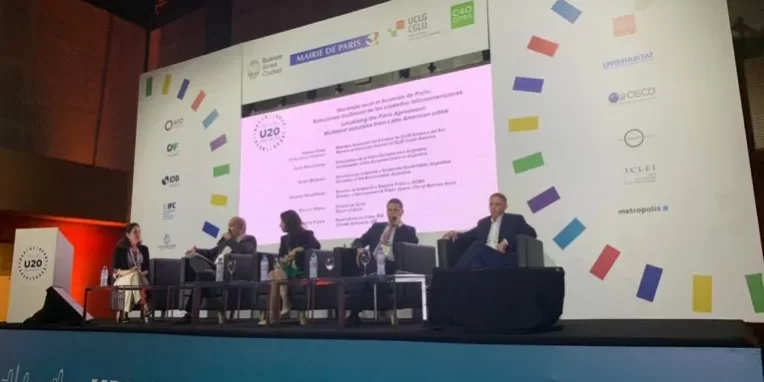
On the occasion of the first Urban 20 Mayors Summit and within the framework of the Global Covenant of Mayors for Climate and Energy, representatives from both cities meet today in Buenos Aires along with representatives from the European Union (EU), the C40 Cities Climate Leadership Group (C40), and ICLEI – Local Governments for Sustainability. The objective is to discuss proposed solutions to reduce Greenhouse Gas (GHG) emissions at all levels in Latin America and the importance of expanding multilevel dialogue and vertical integration of local authorities into national climate investment plans. This would allow cities to access additional funds to address climate change and implement local actions.

They attend the session “Localizing the Paris Agreement: Multilevel Solutions from Latin American Cities,” organized by ICLEI South America, C40, and the City of Buenos Aires. The attendees include Sergio Bergman, the Secretary of Government for the Environment and Sustainable Development of Argentina; Eduardo Macchiavelli, the Minister of the Environment and Public Space of the Government of the City of Buenos Aires; Aude Maio-Coliche, the Ambassador of the European Union in Argentina; Mauricio Rodas, the Mayor of Quito; and Jennifer Doherty-Bigara, the Climate Change expert from the Inter-American Development Bank (IDB). The meeting is moderated by the President and Member of the Honorary Council of ICLEI South America, Patricia Kranz.
This meeting is part of the First Urban 20 Mayors Summit, taking place today and tomorrow in Buenos Aires. Urban 20 is a new initiative led by the C40 movement and the United Cities and Local Governments (UCLG) organization. The initiative aims to be the voice of local and regional governments worldwide. The goal of the Urban 20 meeting is to assist cities around the world in developing inclusive solutions to counter global threats such as climate change, social integration, or the future of work. It also aims to promote the active participation of mayors in the G20 process, positioning their agenda and priorities alongside national governments.

On the first day of the summit, meetings are held focusing on topics such as climate, the future of work, social integration, women’s empowerment, and access to financing. On Tuesday, the mayors will convey their recommendations on these issues to the President of Argentina and host of the G20, Mauricio Macri.
The European Union reaffirms its commitment against global warming. “We recognize that cities are key elements to achieve the success of the Paris Agreement. Therefore, we support the implementation of the Global Covenant of Mayors for Climate and Energy through the International Urban Cooperation Program (IUC),” stated the Ambassador of the European Union in Argentina, Aude Maio-Coliche.