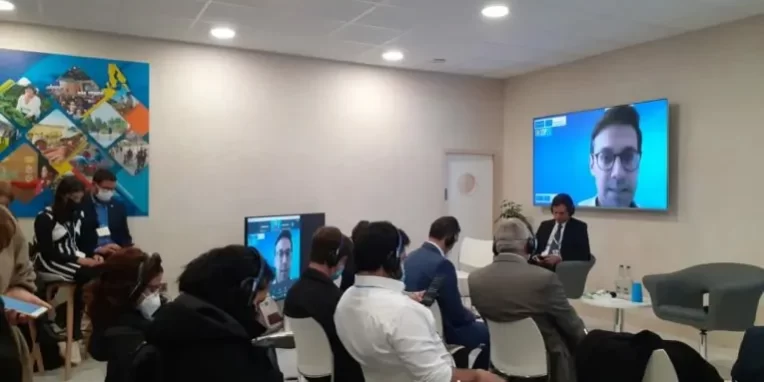
Today, November 8th, the event “Accelerating and Financing the Implementation of Climate Action Plans for Municipalities in Latin America” took place. The event was organized by the Global Covenant of Mayors for Climate and Energy (GCoM) in collaboration with ICLEI South America and the Economic Commission for Latin America (ECLAC). The dialogue, featuring both a virtual and in-person panel, occurred at the Euroclima+ Pavilion during the 26th Conference of the Parties to the United Nations Framework Convention on Climate Change (COP26) in Glasgow, Scotland.
Jordan Harris, the Coordinator of GCoM Americas, led the opening session, which included participation from Stephanie Horel, Programs Officer for the Regional Team for the Americas at the European Union’s (EU) International Cooperation and Development (DEVCO), and Jorge Muñoz Wells, Mayor of the Metropolitan Municipality of Lima, Peru, and GCoM Latin America Representative on the Board.
Stephanie Horel presented the EU’s commitments to the climate agenda globally and in Latin America, emphasizing the importance of expanding leadership in climate action.
“We are supporting this alliance in implementing its climate action plans. We have achieved a lot, especially in Latin America, by engaging many cities in the region in this mayor’s alliance. We have very good plans, and we understand that now is the time to support the implementation of these plans,” highlighted Stephanie.
Mayor Jorge Muñoz Wells spoke about the role of local governments as catalysts for global climate action.
“There is no doubt that the planet has warmed, and we are unfortunately experiencing the effects of climate change, which pose a threat to initiatives for poverty eradication, post-COVID recovery, and above all, sustainable development. It is crucial that financial and multilateral entities provide funding opportunities for climate initiatives and bridge the gaps between planning and implementing climate action plans to ensure a better quality of life, access to affordable housing, and basic services for the population,” emphasized Muñoz.

Pilot Projects and Accelerating Climate Actions
The first panel focused on presenting the methodology, main findings, and contributions of three climate action plans, identifying recommended mitigation and adaptation measures to accelerate their implementation. Implementation challenges were also addressed, highlighting solutions and tools to support cities.
Estefani Rondón Toro, a Consultant-researcher at ECLAC, presented the “Qualitative Analysis Pilot Project to Accelerate the Implementation of Climate Action Plans for GCoM Americas Signatory Municipalities,” conducted in San Jose, Costa Rica; Quito, Ecuador; and Mexico City.
“The analysis focused on implementation, considering that the plans are not the central objective but a preliminary step for the implementation of mitigation and adaptation actions,” highlighted Estefani.
The project aimed to support decision-making on priority actions and guide financing options. Different methodologies were proposed to analyze the plans and improve support for the development of future plans.
Based on the pilot’s main findings, indicators were configured, seeking a holistic evaluation, not only focusing on mitigation and adaptation but also on cross-cutting themes like governance. This approach allowed understanding local and national climate policy frameworks and their linkages with international agreements.
Citizen participation was also considered to understand how different actors participated during the plan development process and its subsequent transparency system for monitoring progress. Gender perspective was included to identify if gender equality, women’s empowerment, and inclusion aspects were already considered in the plans.
Bruno Lana, Economic Affairs Officer at ECLAC, emphasized the importance of considering differences between cities in developing and implementing climate action plans and their priorities.
Emperatriz Ordeñana Ayerdis, Head of the Department of Environmental Services at the Municipality of San Jose, Costa Rica, presented sustainable public transportation initiatives, such as the construction of bike lanes, boulevards, and electric trains.
Leticia Gutiérrez Lorandi, Director General of Coordination of Policies and Environmental Culture in Mexico City, stated that with its climate action plan, Mexico City “achieved the goal of reducing over 2 million accumulated tons of CO2” and that the plans have strengthened the monitoring and evaluation capacities of policies and institutional coordination. Leticia concluded by highlighting that Mexico City has developed a new long-term adaptation plan that focuses on preserving ecosystems, prioritizing nature-based solutions.
Solutions Tailored to the Realities of Local Governments
The second panel presented different perspectives on the implementation of local climate action plans and connected financial institutions and cities to discuss solutions tailored to the realities of local governments.
Three mayors who are members of GCoM Americas participated, presenting perspectives from their municipalities. Renzo Morosi, President of the Environmental Protection Agency of Buenos Aires, Argentina, emphasized the financing needs.
“What we need is to prioritize local governments because they are the ones with the strength, they know the proximity, and where projects are quickly put into action. Many times, funds reach the national level and do not prioritize local agendas. All cities with a comprehensive plan and consolidated goals must be supported because when city goals are achieved, national goals are also achieved,” emphasized Morosi.
In this line, Mayor Pedro Palacios of Cuenca, Ecuador, highlighted the importance of transparency in resource management and the strengthening of internal capacities through international technical assistance and support as vital for the local team to have a global vision and work on complex issues.
The strengthening of capacities of local governments was also emphasized by Mayor Axel Grael of Niterói, Brazil. The municipality has created a climate department to focus on organizing and effectively acting on the climate agenda. For Grael, the prioritization of the local agenda promoted by the Global Covenant of Mayors at COP26 is a positive point.
Financial entities also participated in the dialogue. Carlos Freitas, Advisor to the Global Fund for the Development of Cities (FMDV), highlighted some important strategies, such as creating a strategic alliance of national development banks in Latin America and a global forum for exchanging strategies and products for internal management of these banks, which are different from traditional ones. “The idea is to strengthen national development banks so that they can be intermediaries for large international funds. The financial capacity of local governments is the final step; we need to create these networks of local governments,” emphasized Freitas.
For Augusto Acosta, Project Manager at the European Investment Bank, the priority of local governments must be included in the national agenda. “In development banks, we have fluid and quite regular communication with different national instances. In these spaces, we can take advantage to include these issues, for example, the finance ministries or also sectoral ministries. Local governments are not only recipients of international aid but are direct actors in change,” emphasized Acosta.
Júlio Leite, Superintendent of Public and Socio-environmental Management at the National Bank for Economic and Social Development of Brazil (BNDES), stated that banks like BNDES are hubs between multilateral banks, international organizations, and subnational banks. For this, in addition to climate resilience projects, it is essential to structure projects considering the economic vocation of municipalities.
In closing remarks, Diego Aulestia, Head of the Sustainable Development and Human Settlements Division at ECLAC, concluded: “We cannot forget that by 2030, 86% of Latin America and the Caribbean’s population will be in cities, cities that sometimes have great difficulty accessing financing and require the attention of development banks and long-term financial flows that privilege them. At ECLAC, we see that the region needs to make significant progress, especially in local and national coordination and with international institutions.”