Godoy Cruz is an Argentine municipality located in the province of Mendoza. By signing the Global Covenant of Mayors for Climate and Energy in 2018, we voluntarily committed to combating climate change, reducing its inevitable impacts, and facilitating access to sustainable and affordable energy for all. We were one of the 7 cities to complete the Climate Action Plan, currently in the validation process. We will attempt to outline some of our activities within the framework of the IUC-LAC program and our progress in sustainable urban development.
Since 2016, the Municipality of Godoy Cruz has developed a public policy plan based on five management axes that incorporate the Sustainable Development Goals from a local perspective.
As part of the Argentine Network of Municipalities against Climate Change, environmental policy was deepened with the aim of addressing climate change from the perspective of local power associated with the community. It is considered essential that through concrete actions of the State, citizens align with them, acknowledging the dimension of the threat it represents to humanity.
Since 2013, the municipality has conducted its GHG inventory to analyze generation sources (energy, transportation, and waste) and then take measures to reduce them. The value remained stable until 2016 when a significant reduction began. In 2015, 2.98 tons of CO were generated, while last year (latest report), the value decreased to 2.36 tons of CO, representing a 20.8% reduction in 3 years.
Analyzing the sources, it is observed that 53% of greenhouse gas emissions come from energy, 25% from transportation, and 22% from waste.
To advance in reduction, a plan was developed until 2030, where the ultimate goal is carbon neutrality. This makes us the first municipality in Argentina to have such an ambitious goal.
Regarding energy, the subcategory of residential buildings represents the largest amount of CO2. Therefore, pathways to solar generation equipment (photovoltaic and thermal) for residents are enabled. Energy audits to make consumption more efficient and the labeling of homes (with 120 pilot cases) have been initiated in collaboration with the National Energy Secretariat.
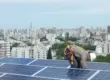
As for the Municipality, 177 photovoltaic panels and 52 thermal water heaters were installed in public spaces and own buildings. This represents the generation of 77,000 kWh per year of solar energy from panels (avoiding 28,490 kg of CO), while thermal water heaters generate 6,600 kWh per year, avoiding the production of 24,420 kg of CO.

Photo of Mirta Elena García de Gómez Plaza, better known as the solar plaza, in one of the neighborhoods of Godoy Cruz. It has 18 panels distributed across three structures, or ‘trees,’ that generate more energy than the plaza consumes.
In addition, the replacement of lighting with LED systems results in a savings of 247,010 kWh per year, thereby reducing 91,394 kg of CO2.
On the transportation front, progress has been made in developing a network of bike lanes, totaling 22 km with an additional 18 km planned. This promotes sustainable mobility through secure infrastructure that connects Godoy Cruz internally and with neighboring jurisdictions. The network is complemented by a free bike lending service, utilized by 12,910 users in 2018, equivalent to 32,275 km traveled, avoiding 8.05 tons of CO2 annually. Additionally, there is ongoing conversion of municipal vehicles, incorporating bicycles and electric cars. This is complemented by the recent acquisition of electric buses by the province of Mendoza, equivalent to preventing the emission of 199.8 tons of CO2 per month solely in our department.

Neighborhood taking advantage of the bike lane that connects the south and north of the department.
We will continue to advance measures aimed at encouraging the use of public transportation and sustainable mobility to reduce emissions from this source.
Regarding the third source, the municipality has 130 points for separating dry waste, distributed in parks, squares, schools, clubs, sports centers, and neighborhood associations, to promote waste sorting in homes, businesses, and industries. On the other hand, the use of polyethylene bags in supermarkets has been prohibited, and the treatment of batteries, low-consumption bulbs, and vegetable oil used by the entire local community is facilitated. In this regard, the waste separation process at the source began progressively, currently advancing in the main commercial areas and six neighborhoods. The challenge is for all residents to separate their waste into two categories next year: organic on one side and dry on the other. The latter represents 30% of the total. Therefore, their reuse and recycling not only prevent them from being buried in the landfill but also promote the circular economy. Regarding organic waste, composting is being worked on, within a residential and neighborhood development scheme for individual treatment. They constitute 50% of what is produced.

Municipal vehicle specifically for waste sorting at the 130 green points and in each neighborhood and business participating in the program.
Finally, regarding climate change adaptation, the municipality has carried out infrastructure works to minimize damage caused by heavy rains (mainly in summer). This includes the removal of dry trees resulting from strong winds (the ‘zonda’ is a characteristic phenomenon of Mendoza, appearing more frequently), which can fall and cause damage. Continuous cleaning of channels and the rational use of water through telemetry sensors for self-consumption and awareness campaigns in neighborhoods have also been implemented. It is worth mentioning that water resource management depends on the province of Mendoza.
This is a brief summary of the main actions we have undertaken in the Godoy Cruz department, with the firm conviction that it is possible to work towards a better planet for our future generations.

Lic. Tadeo García Zazalar
Mayor of the Municipality of Godoy Cruz